More Tarzan covers HERE.
Wednesday, April 16, 2014
Tuesday, April 15, 2014
Overlooked Films: THE GLASS KEY (1935) See it here!
All hail YouTube! I've been wanting to see this first screen version of The Glass Key for thirty-some years and had just about given up on it. Then a couple days ago, while searching for I-don't-remember-what, I stumbled across it on YouTube.
In honor of the occasion, I hauled out the novel and read it for the fifth or sixth time before taking a squint at the film. And guess what? It's a pretty ding dang good movie. Comparisons between this and the better known 1942 version with Alan Ladd and Veronica Lake are inevitable, but I believe I'll save them til next week, after another viewing of that film.
Nothing short of a ten hour mini-series could hope to present all the scenes, characters and storylines of the novel, but director Frank Tuttle did a fine job of boiling the mystery plot down into a feature film. The screenplay, attributed to two folks I've never heard of, retains many lines of Hammett dialogue, and there are several scenes lifted almost word for word from the book. Even the stuff Hammett didn't write sounds like he did. And there's a bit Hammett probably wished was his, when Beaumont clips a girl on the jaw, knocking her out to prevent her blabbing nonsense to the press.
Not surprisingly, because The Glass Key is an almost humorless book, the film added a little comic relief - in the form of a yegg attempting to perform card tricks. The big surprise is what the movie did not add, that being a full-blown romance between the two leads, George Raft and Claire Dodd.
Raft plays Ed (renamed from the novel's Ned) Beaumont, right-hand man and best friend of political boss Paul Madvig, portrayed by Edward Arnold. Madvig is hopelessly in love with Janet Henry (Claire Dodd), the daughter of a senator he's trying to get re-elected. The surface story is a murder mystery, revolving around the death of the senator's son (and Janet's brother), who just happened to be fooling around with Madvig's daughter. That's the part this movie focuses on, and does it well.
Beneath the surface, though, is the love triangle involving Madvig, Janet and Beaumont. That triangle is the driving force behind the story, and brings the novel to a bleak, unhappy conclusion. For Paramount, that simply wouldn't do. So for purposes of this film, they simply eliminated the growing relationship between Beaumont and Janet. Despite Raft and Dodd cozying up on the movie posters, the two characters hardly even meet. Once the crime is solved, instead of facing a shattered friendship and walking away with the leading lady, Beaumont goes on a date with Madvig's sister.
See for yourself. Give this one a look, then come back on Friday for my ramblings about the novel. And next Tuesday we'll bring out the big guns with Alan Ladd and Veronica Lake.
Monday, April 14, 2014
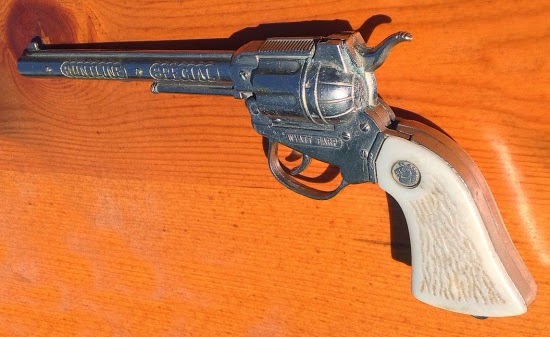
Cap Gun Monday: Actoy BUNTLINE SPECIAL
The jury is still out on whether Wyatt Earp ever carried a long-barreled Colt, but if he did it probably didn't look much like this. Still, while there were a lot of Wyatt Earp cap guns, this is the only one I know of that actually says BUNTLINE SPECIAL on it, which makes it pretty cool. This piece, dating from the late '50s, measures almost 11 inches long, and more than 6 inches of it is barrel.
Aside from the length and the engraving, this looks pretty much like any other Actoy (or Pony Boy) gun, right down to the lanyard ring. We'll see a couple more of them before I deplete my arsenal.
Sunday, April 13, 2014
"The Ballad of Davy Crockett" by Feng Fei Fei and the Stylers
I don't know what this film is all about, but I do see a lot of mountaintops.
Friday, April 11, 2014
Toy Soldier Saturday: MARX PRESIDENTS (Part 1)
Sometime in the '50s, Marx issued a great set of Presidents (up through Eisenhower) done in white plastic to resemble marble statues. I got mine (at a flea market some years back) in a box with a plastic build-it-yourself White House.
In the '60s, I believe, Marx followed up with the painted versions. These were made of cheaper white plastic and hand-painted by "artists," probably sweat-shoppers in Japan or Hong Kong. Surprisingly, the color figures look pretty good in these pics. In person they look cheap and sloppy, especially next to the classy originals.
Old John Quincy Adams looks sort of lonely here. The painted version of him was not in the box with the others, and I can only guess he's out philandering with an intern (or maybe the Ideal princess or Tim-Mee WAC seen previously in this space).
More (but less Presidential) Toy Soldiers HERE.
Forgotten Books: GREEN ICE by Raoul Whitfield (1930)
Green Ice is an appropriate forgotten book—not because anyone is likely to have forgotten it—but because I'd forgotten how good it was.
Over the past couple of years I've read (again) the complete adventures of The Continental Op (many of the later stories more than once) and my brain has become attuned to Hammett's first-person style. And as I've said many more times than once, Red Harvest is my all-time favorite book.
So I was mighty surprised to discover what I had obviously forgotten—that in Green Ice Raoul Whitfield was aping Hammett's style—and doing a dang good job of it.
The story first saw print as a 6-part serial in Black Mask, beginning in December 1929 (along with part 4 of the serialized Maltese Falcon). Though green ice provided the motive for most of the killings, it failed to get the title role. Instead, the serial was called "The Crime Breeders."
Our hero, Mal Ourney, is fresh out of prison, where he served a stretch for a crime he didn't commit. Being an honorable guy, he took the rap for his ladyfriend, and apparently did it without complaint. While in the big house he learned plenty about crime, and devised a mission—to bring down the folks he calls The Crime Breeders, the upper echelon crooks who infect others with the disease and start many an otherwise innocent soul on the road to ruin.
Trouble is, he did too much blabbing about it in prison. Now everyone knows what he's up to, and the Breeders go on the offensive, to stop Mal from eradicating them.
The Hammett flavor is there in the first scene, and sticks till the end. The first human Mal encounters on the outside is his old flame Dot—the one he did the stretch for—but he's over her and gives her the air. As Mal tells the story:
I turned my back and walked away. Dot kept right on yelling. She was using up a lot of her old words, and she contradicted herself twice in every sentence. It sounded to me like a lot of after-the-gin raving. I got self-sympathetic.
Then:
The cab door slammed. Her final words were to the point, but they weren't true. Jane Ourney had been a lot of grief to Sam Ourney, but I was their honest-to-god brat.
Foul-mouthed Dot is the first of many bodies to drop, and each one puts Mal in a deeper hole. While struggling to dig himself out, he runs afoul of a bunch of folk itching to get their hands on a pile of huge emeralds, and joins forces with a liberal-minded cop to sort out who killed whom and why.
I enjoyed Green Ice so much I immediately started rereading Whitfield's second mystery, Death in a Bowl. And guess what? I'd forgotten how good that one was, too. Stay tuned.
Thursday, April 10, 2014
Wednesday, April 9, 2014
Subscribe to:
Posts (Atom)