Friday, July 24, 2015

Forgotten Books: THE SHADOW UNMASKS (1937, 2008)


Will Murray's new Doc Savage novel The Sinister Shadow (reviewed HERE), put me in such a Shadowy mood that I decided it was time to finally take a look at The Shadow Unmasks.

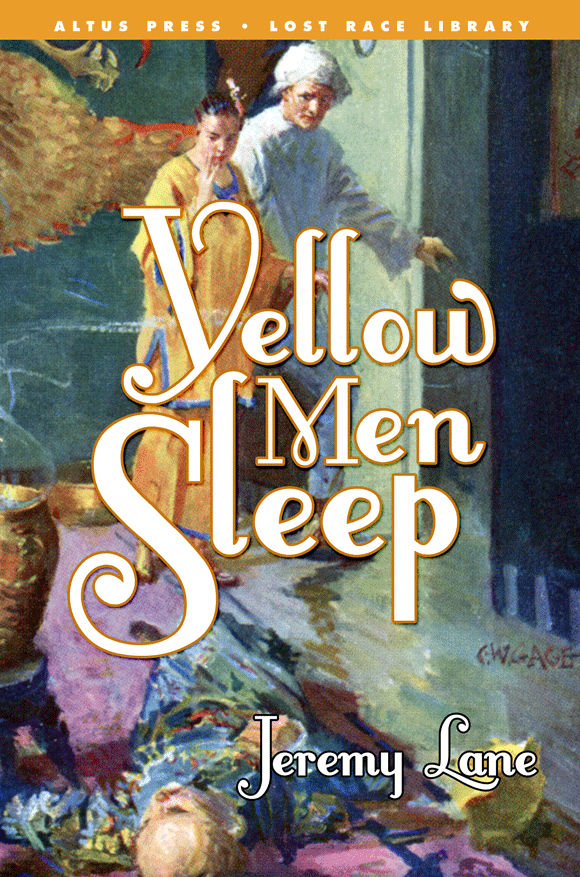
That story, from the first August, 1937 issue of The Shadow's mag, was finally reprinted in 2008, paired with the tale that followed two weeks later, The Yellow Band.

Figuring this would be a special story, I'd been saving it until I was in just the right mood. But while I was right about being in the mood, I was wrong about the story. It involves a fairly clever jewel theft scheme, but there's very little mystery because the reader (and apparently the Shadow) knows what's happening right from the start. The best that can be said is that our hero is involved in a couple of good shootouts along the way - but isn't he always? And his number one agent Harry Vincent faces a creative torture method. He's trapped in a Chinese laundry and stretched on a rack made of ironing boards and laundry wringers. Aside from that - blah.


The setup for the Shadow revealing his identity is more interesting. As depicted on the cover, The Shadow, in the guise of Lamont Cranston, meets police Commissioner Weston outside his club. Then an incovenient newsboy provides a paper announcing that Cranston (this being the real Cranston) has been injured in a plane crash in Europe. Temporarily denied the use of his favorite false identity, the Shadow makes the peculiar leap of logic that his best course is to revert to his true (and heretofore unnamed) secret identity of Kent Allard, an aviator thought to have crashed in the South America some twelve years earlier.

Smack in the middle of the story, in a scene unrelated to the jewel theft plot, the Shadow reveals himself to a friend, and tells his tale. He was, we learn, an Ace fighter pilot in WWI. Known to the enemy as The Dark Eagle, he worked as a roving secret agent behind the lines, where he presumably honed his shadowy skills. After the war he flew to Guatamala and cultivated a friendship with the Xinca Indians, who believed him to be a god from the sky. He then came secretly to New York, where he adopted the identity of the Shadow.


The Dark Eagle stuff seems well thought out, and is backed up by passages in several earlier adventures. But the Guatamala angle is a bit goofy, and smacks of something Walter Gibson dreamed up on the spot.

That Gibson was on a spot is revealed by Will Murray in the Nostalgia Ventures reprint. With the premiere of the Shadow radio program fast approaching, and presenting the simplified notion that the Shadow and Cranston were one and the same, the Street & Smith Poo-Bahs ordered Gibson to reveal the Shadow's true identity pronto. The logic of this escapes me, but the result was that Gibson was forced to come up with this yarn quickly. My guess is that the jewel robbery stuff was already plotted - if not written  - and he just inserted the Kent Allard story to keep his bosses happy.

As pointed out by Frank Eisburger Jr. in Gangland's Doom (a former Fogotten Book, HERE, and now available in a new edition from Altus Press), the details of Allard's wartime and post-war activities, in addition to the origin of his girasol ring, do not jibe with much of what was said in earlier novels.

Bottom line, the Shadow's unmasking (aside from the great cover) was far less dramatic and satisfying than it promised - and deserved - to be.

Thursday, July 23, 2015

DOC SAVAGE meets THE SHADOW: "The Sinister Shadow" by Will Murray


I am in awe of this book.

Pulp fans like me have been dreaming about a Doc/Shadow encounter for decades, and The Sinister Shadow is everything we could have hoped for.

We’ve known for a long time that Will Murray inherited the style and wit of Lester Dent (by my count, this is his 17th Doc Savage novel). This novel makes it clear he’s somehow in communication with the spirit of Walter Gibson as well. And Mr. Dent actually lends a hand from beyond the grave, because portions of this book are based on unused chapters and scenes from a Shadow novel he wrote before becoming the first “Kenneth Robeson.”

The action takes place early in the careers of both heroes, most likely in 1933 or ’34. The Shadow is still so mysterious that his very existence is in doubt. Doc and the gang know him only as a creepy voice on the radio. Faced with the notion that he’s a real being, they have no way to know which side of the law he’s on. Meanwhile, though the Shadow knows Doc is a good guy, trust and cooperation are not his strong suits.

This sets up a great dynamic in which Doc’s crew and the Shadow’s agents, as well as the two big cheeses themselves, are battling each other rather than focusing on their common foe, a death-obsessed mastermind called the Funeral Director.

Will Murray does a masterful job of integrating the worlds of the two series, and it works so well it’s a wonder Dent and Gibson never tried it themselves. Doc interacts with Commissioner Weston and Detective Joe Cardona. Ham Brooks meets Lamont Cranston. Monk Mayfair and Johnny Littlejohn tangle with Harry Vincent, Clyde Burke and Cliff Marsland. The Shadow makes an undercover visit to the 86th floor of the ESB, and Doc invades the Shadow’s sanctum. The Cobalt Club and the Crime College come into play, and we’re even treated to a dogfight between the autogyro and the gyroplane. 

Yep, it’s all* here. All the trappings from each series, interwoven into one BIG story that had me smiling from beginning to end. This is a book I’ll definitely be reading again.  

Every pulp fan will want a copy of this. Here's where to get it: THE SINISTER SHADOW.


*Thankfully, there is no Margo Lane. She debuted on the radio in 1937 and didn't infest the pulps until 1941.

Monday, July 20, 2015

Zombies Over Yonder and The Phantom Empire: A few words from Stephen Mertz


Steve offers these thoughts on writing Zombies Over Yonder:

When I decided to have some fun and shake up the Blaze western series a little with the new one, Zombies Over Yonder, I returned for inspiration to my introduction to the western.

See, I didn’t really start to read and appreciate western fiction until I was in my late thirties. But I sure saw a lot of western movies before that and while my favorites are nearly all A-listers like High Noon, Unforgiven, etc., the fact of the matter is that I must place credit (or blame) for this latest Blaze entry directly at the feet of Gene Autry and The Phantom Empire.

The Phantom Empire is a 12-chapter movie serial made in 1935. Gene plays a singing cowboy who gets involved with bad guys who arrive in an airplane and speed around in cars, an underground kingdom of robots, ray guns and bad guys and a hottie queen. Shooting, singing and fisticuffing his way through this wild mix, Gene always manages to make it back to Radio Ranch in time for his daily broadcast…only to be pitched directly back into all that cowboy craziness as soon as he’s off the air.


I was an impressionable 8-year-old, watching this spectacle unfold in 15-minute increments every day after school. It was my first exposure to a western movie, and my impressionable brain apparently (and no doubt gleefully) absorbed the notion that a western was set in a wild, wondrous time and place not hobbled by the restraints of reality. As an adult Southwesterner with some awareness of this region’s history, I’ve come to accept that, yes, real life cowboys did ride horses and no doubt sang an occasional song, but they most certainly did not fight robots outfitted with ray guns in underground kingdoms.

Still, if you crumple up your disbelief and pitch it into the next area code, I think it’s still kind of cool to imagine and, thankfully, I’m not alone in my taste for a genre that has come to be known as the “weird western.”

Make no mistake. Blaze #6 is a “real” western in that there is much excitement, burnt gunpowder and hard ridin’. There are no ray guns or underground cities. Still, it is a fun romp through a fictional western landscape that has entertained over the years in film (the immortal Jesse James Meets Dracula, etc), the comics (Jonah Hex), and right up through recent Hollywood classics like Cowboys & Aliens (2011).

This is the range Kate & J.D. are riding in Blaze! #6, a rave-up that sure as hell ain’t The Searchers or Shane. But dang it, sometimes it’s just fun to have fun.

Here’s your invitation to join in!


Click HERE!

Sunday, July 19, 2015

The Art of TOM ROBERTS (Part 10): Nooses Galore!


When Richard "Tip the Wink" Robinson scanned these Tom Roberts paintings for me, he mentioned that the publisher, Crippen & Landru, likes to have a noose somewhere on each cover. Some of these are mighty cleverly hidden, and it took some work to find them. Here's a cheat sheet for you. 


Catch up on Parts 1 thru 9 HERE.