Friday, August 10, 2012

Forgotten Books: Black Wings Has My Angel by Elliott Chaze (Soon to be a Major Motion Picture)

Can a 1952 Gold Medal original be considered literary fiction?

No way, I thought. But that was before I read Black Wings Has My Angel. Now I’m just sitting here stunned by the power of this guy’s prose.

There’s no denying this is a crime novel. Along the way, our escaped convict protagonist and his black-winged angel commit a brutal murder, pull off an elaborate armored car heist and stage a jailbreak. But Elliott Chaze refused to let that stuff get in the way of his writing. He just turned his fingers loose on the typewriter and made magic.

In a way, it’s too bad Black Wings Has My Angel was written way back in ‘52, because back then readers and publishers didn’t really know what to do with a book like this. Today, they’d know exactly what to do with it: they’d give it an Edgar nomination for Best Novel of the year.

The story revolves around a love-hate relationship between our narrator - an ex-POW, ex-con on a mission to pull off a spectacular crime - and a blue-blooded call girl with a cash register for a heart. As hard as they try to be rid of each other - and they try plenty hard - they keep crashing back together. And somehow, you just know that all roads lead to ruin.

Here’s a sample of Chaze’s prose:

     In Dallas I got turned around somehow, and drove out though a plush Home-and-Garden-Club kind of neighborhood, where all the houses were of long thin wafers of Roman brick or blotchy fieldstone and were set far back from the road, their picture windows shining like gold foil in the late sun. We passed what must have been some kind of club, and there were limber-legged young kids on a strip of fine clay, striking brand-new white tennis balls with a beautiful laziness, their expensively coached strokes almost indolent. Then we came out of that part of town and there were some grubby youngsters batting an old gray ball around a gray asphalt court, a public one with ragged chicken-wire backstops. These kids played aggressively, jumpy and fast, the movements ugly and determined. They beat the ball as if they were killing a snake.
     “It’s funny,” she said to me, “they can be playing the same game and yet an altogether different one. It’s the money.”
     “Yes.”
     “Everything stinks without the money.”
     “Almost everything.”
     “Some day I’m going to wallow in it again. I’m going to strip down buck naked and bathe in cool green hundred-dollar bills.”

When I read that passage early in the book, the tennis scenes were so vivid that the stuff about bathing in money didn’t make much of an impression. Much later, though, I had cause to remember it. And it struck me that Chaze must have been a Carl Barks fan. Because when the bathing-in-bills scene rolls around, it’s straight out of Uncle Scrooge:

I saw the light inside the armored car, glowing in slitted shapes through the steel. The rustling was louder.
     She was sitting on the floor naked, in a skitter of green bills. Beyond her was the custodian, still simpering in death. She was scooping up handfuls of the green money and dropping it on top of her head so that it came sliding down along the cream-colored hair, slipping down along shoulders and body. She was making a noise I never heard come out of a human being. It was a scream that was a whisper and a laugh that was a cry. Over and over. The noise and the scooping. The slippery, sliding bills against the rigid body.
     She didn’t know I was alive. 

A British edition with a jazzier cover.

The word on the ‘net is that a movie version is in the works with Tim Huddleston (Loki from Thor and The Avengers) and Anna Paquin in the lead roles, and Elijah Wood playing someone named Eddie. I don’t remember an Eddie from the book, so don't know what Wood is doing there, except adding star power. The film is targeted for a 2013 release.

The Gold Medal edition of this novel is mighty hard to find, but Stark House has made it readily available, paired with Bruce Elliott’s noir thriller, One is a Lonely Number, which I reviewed on Wednesday (that’s HERE). I was impressed with One is a Lonely Number, and recommend it highly. But Black Wings Has My Angel is even better. They make a dynamite pair. But wait! You also get words of wisdom from misters Gorman and Crider! The Stark House Double is HERE.


More Forgotten Books at Sweet Freedom.

Wednesday, August 8, 2012

One Is a Lonely Number: forgotten noir from Bruce Elliott

Until I read One is a Lonely Number, Bruce Elliott was just a name on a list of authors who occasionally masqueraded as Maxwell Grant to give Walter Gibson a breather on The Shadow.

No more.

Now he’s a gritty noir writer who ranks right up with the best of them.

The “hero” of this 1952 novel is an unrepentant convict who, with nine other hardcore criminals, has just busted out of Joliet Prison. As news reports tell of the other escapees being caught one by one, Larry Camonille - the brains of the breakout - is determined that won’t happen to him. A prison operation has left him with only one lung, and his only hope is to find refuge in a drier climate - like Mexico.

Camonille has brains, and proves it in the way he steals his getaway money - he holds up a “tea” (read pot) party on Chicago’s South Side, where the victims can’t run to the law. Then he takes the smart route out of town - catching a freight in a hobo jungle. And he does avoid the law, but falls victim to crooks even more ruthless than he is.

Dead broke and discouraged, Camonille lands in a small town in Ohio, where his smarts go out the window, and he finds himself ensnared by two women with ruthless plans of their own. One’s a rich, oversexed middle-aged alcoholic who wants him to commit murder, and the other is a an irresistible, oversexed epileptic teen who want him to rob a bank. Camonille knows he should run for the border, but the breaks keep going against him.

And then he gets the worst break of all - he falls into something that might be love.

Elliott’s prose is tight, tough and laconic, and he knew what he was doing. We’re not supposed to like Camonille, because he really is a scumbag, but we do come to identify with him. How did Elliott do it? Beats me. Maybe he knew what Evil lurks in the hearts of men, and appealed to his reader's inner scumbag.

All I know is, I liked this novel, and I’m pleased to report Stark House has given it new life, teaming it with the Elliott Chaze novel, Black Wings Has My Angel.  That's available HERE. I’ll be reporting on the second half of this Stark House Double in Friday’s Forgotten Books.

Tuesday, August 7, 2012

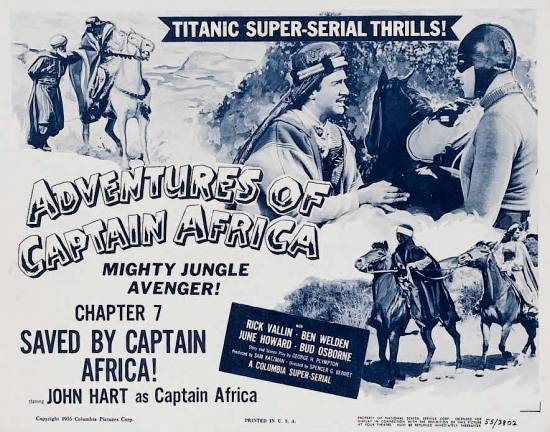
Overlooked Films: Adventures of (ALMOST the Phantom) Captain Africa


Last week I yakked about the 1943 Columbia serial The Phantom starring Tom Tyler. That’s HERE.

Well, recently Mr. Richard Prosch (who hangs out on Meridian Bridge) tipped me to the fact that Columbia was in the process of filming a sequel, with part-time Lone Ranger John Hart in the title role. But things went sour when the studio lost the rights to the character. Their solution was to create a pseudo-Phantom called Captain Africa.

I haven't seen this serial, but based on what I see in these lobby cards, the studio didn’t change much. Hart’s mask looks identical to Tom Tyler’s. Instead of a cloth hood he has a leather aviator’s cap. And instead of the Phantom’s gray long johns, he wears a turtleneck and riding britches. Though he’s now a government agent instead of a jungle god, he still appears to be worshipped by the natives. And the natives, as in the first serial, are white. And though I haven’t seen a lobby card with Devil (or a reasonable facsimile) on it, one of the later chapters is titled “Captain Africa and the Wolf Dog!”

So, now that I know that Adventures of Captain Africa (1955), was ALMOST another Phantom serial, it’s on my to-be-seen list. 

BILL CRIDER TAKE NOTE! Chapter 4 is titled "Into the Crocodile Pit!"

More Overlooked Films at SWEET FREEDOM.

Here's a pic of Hart in the Phantom suit, before the franchisee pulled the plug.


Friday, August 3, 2012

Forgotten Books: Roy Rogers and The Ghost of Mystery Rancho by Walter A. Tompkins


This is one of the better Roy Rogers novels, because as far as I know, it’s the only one written by a genuine western pulp writer.

Walter A. Tompkins wrote for a lot of pulps, and wrote a lot of western paperback novels, but I know him best from the Thrilling Publications line, where he provided many lead novels for Rio Kid Western, Masked Rider and Range Busters.

Roy Rogers and the Ghost of Mystery Rancho (1950) starts when a Texas Ranger captain invites Roy to help solve a mystery down near the Mexican border. Evil doings surround the Box C ranch, known locally as “Mystery Rancho,” and four lawmen have disappeared without a trace.

But before Roy can get into action, the ranger is gunned down by a talking skeleton. The man’s dying request is that Roy don his badge and finish his job. It turns out he has two main enemies. One is a tattooed Mexican gang leader called Senor Rattlesnake, and the other is a guy who rides around wearing a skeleton costume and a cowboy hat. This second guy - the mystery man of the piece - calls himself The Ghost.

It soon develops that the two villains are in cahoots, and their master plan is a large scale counterfeiting operation.  You know, of course, that Roy is going to survive, because he still a has a lot of movies - and a TV series - to make. But along the way he gets into some fixes worthy of Republic cliffhangers. At one point he’s buried up to his neck in quicksand (and no, Trigger does not pull him out), and later he gets hanged, and is still hanging when the buzzards arrive for breakfast.


Along with Tomkin’s purple prose, we’re treated to seventeen interior illustrations by Andrew Bensen, who also had some pulp experience. You can see covers he did for Weird Tales and Real Detective Tales HERE .

For more Forgotten Books, I invite you to mosey over to SWEET FREEDOM.


Wednesday, August 1, 2012

TOUGH AS NAILS: Frederick Nebel's complete Donahue series from Black Mask


Every time I read Frederick Nebel I’m surprised how good a writer he was.

I shouldn’t be surprised, because I’ve been reading him off and on for a long time, but that’s the way it is.

And when I delved into this new Altus Press collection, Tough as Nails, I was more surprised than ever, because to my mind, these “tough dick” Donahue stories present Nebel at the very top of his form. If you like hardboiled fiction, and have never read Frederick Nebel - this is definitely the place to start.

Tough as Nails collects all 15 Donahue stories, originally published in Black Mask between 1930 and 1935. Six of them were featured in the Avon paperback Six Deadly Dames way back in 1950, and a couple of others have appeared elsewhere over the years, but most  are reprinted here for the very first time.

Donny Donahue is a private detective, the ace operative of the New York branch of the Interstate Detective Agency. As Will Murray points out in the introduction to Tough as Nails, the timing of Donahue’s debut is significant. Hammett had all but abandoned his number one Black Mask hero, The Continental Op, and editor Joe Shaw needed another agency dick to replace him. Enter Donahue.

But though Donahue works for an agency, he’s definitely NOT based on Hammett’s Op. If anything, he was inspired by Hammett’s other Mask detective, Sam Spade. As in The Maltese Falcon, (a book Nebel owned and clearly read more than once) the third-person narration of the Donahue stories is ultra-objective. We’re never inside Donahue’s head, never privy to his thoughts and emotions. We’re simply very close observers.

We do get to know him, of course, the same way we get to know Spade - through his expressions, his body language, his speech, his actions, and the way other characters react to him. Nebel was a master at putting the fine points on every detail, and that’s one reason I’m so much in awe of his writing. All those details come together to create a strong picture of the character Joe Shaw liked to bill as “tough dick” Donahue. With good reason. Donahue was one of the toughest dicks every to walk the pages of Black Mask. And Nebel’s diamond-hard prose complimented him perfectly.

The bad news is there are only 15 Donahue stories, so no matter how long you space out your reading, you’re eventually going to run out. The GOOD news is that Nebel created a Donanhue clone named Cardigan and put him to work in Dime Detective, where he appeared in a whopping 44 more stories. The BEST news is that Altus Press will be reprinting that entire series too. The Complete Casebook of Cardigan Vol. 1 is already available, with three more volumes to come.

Both Tough as Nails and The Complete Casebook of Cardigan Vol. 1 are available HERE.

Tuesday, July 31, 2012

Overlooked Films: The Phantom (1943)


These days, comic book superheroes in tights are a dime a dozen. But the guy who started the trend was a comic strip hero, who first wore his underwear in public back in 1936.

This is him - The Phantom - who finally got around to making his motion picture debut in 1943. And surprisingly, they got the costume right. My only quibble is that in some scenes, his tights looked more black than gray.


This 15-chapter serial starred cowboy hero Tom Tyler, who’d demonstrated his superhero chops in the 1941 serial Captain Marvel. I have to give Tyler a slightly lower score than his costume, but overall he made an acceptable Ghost Who Walks.

First off, when Tyler runs through the jungle, he looks like Tiny Tim tiptoeing through the tulips. But his worst offence comes at the end of Chapter 1, when the Phantom falls into quicksand and is menaced by a hungry crocodile. Anyone who’s read the comic strip knows how the real Phantom responds to the prospect of certain death: He makes a wisecrack. Not so, our Tom. Instead, he cringes, grimaces, wiggles and is afflicted with an extreme case of jazz hands.


So how does he escape at the beginning of Chapter 2? He keeps on cringing, grimacing, wiggling and jazz-handing until Devil saves his butt. In fact, Devil saves his butt in about one of every three chapters. The only problem with Devil is - he’s supposed to be a wolf. Here, though, he’s just a dog, proudly portrayed by Ace the Wonder Dog. Not that there’s anything wrong with that. Except, of course, that he’s supposed to be a wolf.


Then there are the natives. This is darkest Africa, right? And since we’ve all seen plenty of Tarzan movies, we know what African natives are supposed to look like. Here, they look like a cross between Wild West Indians and South Pacific Islanders.

STILL, once you get past the jazz hands, Ace the Wonder Dog and the homogenized natives, it’s a pretty decent serial. Most of the cliffhangers are okay, the dialogue is a couple of steps above dumb, and there are more fistfights than you could shake a fist at. And heck, this is the Phantom (sort of), so despite its flaws, this serial is required viewing.

More Overlooked Filmy stuff at SWEET FREEDOM.

Friday, July 27, 2012

Forgotten Books: SHAKEDOWN by Roney Scott (William Campbell Gault)

Shakedown (1953) was William Campbell Gault's first private eye novel, and the first of eight books featuring the rough-around-the-edges womanizer, Joe Puma. But I'm pretty confident in saying that when Gault wrote it, he had no intention of turning Puma into a series character.

Joe Puma bears all the earmarks of a use-once-and-dispose detective. Like the dark heroes of novels by James M. Cain, Harry Whittington and Charles Willeford, Puma is far more interested in sex and money than he is justice - or the welfare of anyone but himself. The story, too, bears little resemblance to the average private detective plot. Though it begins with a murder, the lead-off killing has its roots in Puma's earlier illegal activities, and he's quickly sucked into a complex con game with three other unsavory characters, each of whom hopes to cheat the other three. And just for kicks, there are prostitutes and lesbians thrown into the mix.

Then there's the pen name, Roney Scott. Gault used this a couple of times in the pulps, when he had two stories in the same issue of a magazine. In this case, I'm guessing it was more of a stylistic decision. He'd already written two stand-alone mystery novels under his own name, and would follow this one with three more. All of those were more traditional - or at least more sedate - mysteries. And those first two novels were published in respectable hardcover, while this one seemed more of a throwaway as an Ace Double original.

Shakedown gets off to a daring start simply by revealing the details of Puma's previous case. Here's a Hollywood story that would have made Spicy Detective's Dan Turner blush:

     Rickett had a yen for sweet young stars, and Bea Condor had been one of those. Rickett, it seemed, was overendowed and Bea had suffered. He'd taken her to a quack, and she'd died. 
     Enter Target, who had a string of call girls for the money trade. Target had sworn on the witness stand that Bea was one of his girls and that she was famous for a trick involving the disappearance of a beer bottle. That took care of the dead girl's reputation, though there wasn't a shred of truth in any of it.

An unusual murder weapon, don't you think?

One more thing. Though it's not a big deal in the story, we learn that Puma played three years for the L.A. Rams. Gault would re-use that resume in 1955, when he introduced his best known character, straight-arrow detective Brock Callahan in the novel Ring Around Rosa (aka Murder in the Raw).

Joe Puma, meanwhile, did not resurface until 1956, in a series of stories published mostly in Manhunt, and finally resumed his novel career in 1958 with End of a Call Girl.

Forgotten Books? Me too. Lots of 'em. Refresh your memory at pattinase.