Friday, July 18, 2014

Forgotten Books: DAY OF THE RAM by William Campbell Gault (1956)


A couple of weeks ago I re-read Ring Around Rosa (aka Murder in the Raw), the first appearance of private investigator Brock Callahan, and complained because he was grabbing his ankles and taking too many whacks from the police. That's HERE.

Well, Brock returns in Day of the Ram, and while his nose is still a little brown for my taste, he's showing signs of improvement. Plus, as the title - and the cover - indicates, this one is directly involved with Brock's former profession as a guard for the L.A. Rams. So I have to give Day of the Ram at least a thumb and a half up.

Football has changed a little since 1956. Brock tells us that lineman like he was are are bit players who make no more than a living wage. And there’s this observation about the players in general: 

Some of them earned less here, as pros, than some of the others had earned as amateurs in college.

Along with the football, Gault paints a great picture of L.A. in the fifties. Here's a sample:

Somebody had described Los Angeles as a dozen shopping centers in search of a town. It isn’t quite that. Areas have names of their own out here, but Hollywood is still Los Angeles and so is Westwood. And so are Brentwood and Bel-Air. But not Beverly Hills or Culver City or Santa Monica; they are distinct and separate municipalities, island surrounded by the creeping fungus that calls itself Los Angeles.

Another nice passage: 

Ned Allen had said “this town,” but that’s just a phrase. He meant the Los Angeles area - all the town roughly identified as “this town” of Los Angeles. It’s really not a town at all, but a collection of attitudes. 


The paperback cover tells us Brock is tough, but he has some odd ways of showing it. After an encounter with an insensitive bartender, he pays for his forty-cent beer in five pennies and “the dirtiest coins I could find.” And when his girlfriend's neighbor's doberman barks at him, he spits in the dog's face. Yeah, he's got a long way to go, but that's an improvement over Ring Around Rosa.

There are some nice touches of the times. His former teammates kid him about his new profession, calling him "Dick Tracy" and "Fearless Fosdick." He overhears a man half-joking with his wife: "Some day, Alice - pow!" And when he's jailed by a detective with a bad case of B.O. The detective asks:

     “Anything witty to take back to the boys in the squad room, Callahan?”
     I smiled at him through the bars. “I’m glad I use Dial. I just wish that everybody did.”

And here's a cool tip of the fedora to Raymond Chandler:

     The Chief of the Santa Monica police was certainly a dandy. A little man with an unctuous voice, looking at me across his big, expensive desk, and sadly shaking his head.
     “What else could we think, Mr. Callahan? A respected businessman in our community claims you came in brandishing a weapon. Whose story would you believe, if you were in my position?”
     “Since when is a bookie joint a respected business?” I asked him.
     He frowned at me, horrified. “Evidently you don’t know our little town.”
     “I read about it,” I said, “but the writer called it Bay City.”
     “There’s no gambling here, not while I’ve been chief.”
     “Yes, Virginia, there is a Santa Claus,” I said humbly.

Next up in the Callahan series is The Convertible Hearse. I believe I'll take it for a test drive.

Your weekly round-up of arcane literature is at pattinase

Tuesday, July 15, 2014

Overlooked TV: JOHNNY RINGO (1959)

The real John Ringo, as you may know, was a cow thief. Films like Tombstone have portrayed him as a particular rival of Doc Holliday, because someone once said he was better educated than the average cowboy. The most interesting thing about him is the mystery of his death. He was found sitting against a tree with his boots missing and a bullet hole in his head. One unlikely theory, attributed to Wyatt Earp, says that Earp and Holliday returned to Arizona in 1882 (despite being wanted by the law) to do the deed.

In the 1959 CBS series Johnny Ringo, our man Johnny was your typical good-guy sheriff, who just happened to have a bad guy past. The series only lasted one season, so it did not foster a boatload of merchandising. There was, however, one comic book (Four Color 1142, 1961), several cap gun sets from the Actoy company, and a Marx playset.

Unfortunately for Marx, the show was cancelled before the set went on sale, so the playset had a very limited run. As a result, it's now an extremely rare set, and Johnny is one of the rarest of Marx figures. If you find him lurking in your toybox, he could bring you several hundred bucks.

Here's a full episode of the show, complete with educational commercials for Kent Cigarettes.


The super-rare Marx Johnny Ringo figure, obviously based on the still above. 
Not even super-collector Cap'n Bob Napier has one of these. 

These cap gun pics are featured on the world's most 
amazing cap gun site, nicholscapguns.com. Check it out!

In the show, Johnny's gun has extra barrel bearing 
a shotgun shell. Too bad the cap guns didn't.

Monday, July 14, 2014

Cap Gun Monday: HUBLEY RIC-O-SHAY .45


At twelve inches long and nearly six inches tall, the Hubley Ric-O-Shay is second largest western cap pistol I own. (I posted of video of the biggest, the sublime Hubley Colt .45, HERE.) This one is even bigger than most real real handguns, and it makes a cool ricoshet sound (hence the name) as the trigger snaps back. 

It has no connection, other than pronunciation, to Stan Lynde's long-running comic strip featuring cowboy hero Rick O'Shay. Hubley also made an unimpressive Ric-O-Shay Jr., which we'll see further down the line.


More undeadly weapons HERE.

Saturday, July 12, 2014

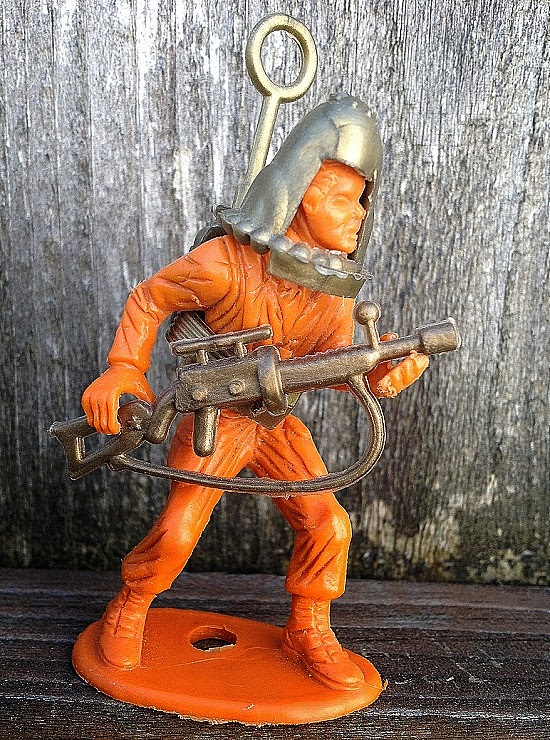
Toy Soldier Saturday: MPC SPACEMEN


Toy soldiers made by the Multiple Plastics Corporation were always inferior to those of Marx, but while Marx merely toyed around with the use of separate accessories, MPC went for it in a big way. 

This line of MPC soldiers is known collectively as Ringhands, because many of the early figures had holes bored through their hands to accommodate weapons and other tools of their trade. Later figures, like these space explorers, had empty, grasping hands rather than true rings. (For a look at true Ringhands, check out the very cool MPC pirates HERE.) 

MPC saved a few bucks on these space guys by using molds made for their WWII soldiers, then casting them in colors other than olive green. A kneeling figure, designed to wear an army helmet and aim a rifle, was also included in the spaceman set, but he wasn't fit for missions because none of the space accessories fit him. 


More Toy Soldiers HERE.

Friday, July 11, 2014

Forgotten Femme Fatales: Cleve F. Adams' VIOLET McDADE in "The Voice" (Read it Here!)


Circus fat-lady turned private detective Violet McDade is not your typical femme fatale, but she's a definitely a femme, and there are few more fatal. With her partner (and narrator), the slim, trim Nevada Alvarado, she starred in at least a dozen novelettes in Clues Detective Stories. Violet packs a pair of .45s at all times, and welcomes any excuse to start slinging lead. In one tale, after gunning down a lady murderer, she deliberately steps on her rather than walk around.

"The Voice," from the Sept. 1936 issue, actually delivers three femme fatales for the price of one. Along with Violet, we get Nevada and her high-society pal Kay, a suspected dope smuggler. Cleve Adams obviously had a lot of fun writing this story, and I had fun reading it. I think you will too.


Your FFB Femme Fatale Headquarters is pattinase