Showing posts with label James Hadley Chase. Show all posts

Tuesday, April 11, 2017

FREE James Hadley Chase books (Yep, REAL Books)


UPDATE (6:26am):
I got a taker. The books are gone. 
Thanks for looking!

These two unread trade paperbacks are looking for a good home -- with someone willing to review them (anywhere you like). That's it. Free shipping, too.

I have only one copy of each. First responder is welcome to either or both. Comment here or email me at delewis1@hotmail.com. I'll revise this post when the books are gone, so until then, fire away.


Friday, April 7, 2017

Forgotten Books: TWELVE "CHINAMEN" and a WOMAN (1940)


Yeah, I know the real title of this book, and so do you, but the copy I read said “Chinamen,” so I have a valid excuse (other than a creeping case of pc-itis) for calling it this.

Published in 1940, this one finds Dave Fenner, the extra-hardboiled detective introduced in No Orchids for Miss Blandish (reviewed HERE)having moved his office from Kansas all the way to New York City, and taken his office assistant/secretary Paula Dolan with him. His work on the Blandish case brought him plenty of jack, and his name is known far and wide, but there still isn’t much business coming through the door.

So Fenner and Paula are pleased to get a visit from a good-looking dame who gives them $6,000 to save her sister, who is somehow mixed up with 12 Chinamen. The opening scene is loaded with overtones of the opening chapter of The Maltese Falcon, making it one of the best in the book. Then a defunct Chinaman with a slit throat appears in Fenner’s office, and when he goes looking for his client, he finds only a severed arm and a female torso missing legs and head. In between there somewhere, a couple of Cubans show up to search his office, bringing shades of Joel Cairo.

The trail then leads to Key West, taking Fenner away from Paula, which is too bad, because their interplay is the best thing about this (and the Blandish) book.

Once in Florida, the story shifts into Red Harvest mode, with Fenner cozying up to two gang leaders in hopes of starting some fireworks. There’s plenty of tough talk, face punching, head kicking and other such mayhem, but almost no humor, as Fenner bulls his way through the Key West underworld.

The title is taken from a line of dialogue, and refers to the preferred racket of one of the gangsters. He smuggles twelve Chinamen at a time into the country, charging them around a thousand apiece for the privilege, then sells them for half that to West Coast employers. On the run Fenner takes part in, a “special” is included, that being a Chinese woman.

Yes, there are at least a dozen Chinamen in this book, but none play major roles. There’s a seemingly endless supply of nasty gun-toting Cubans, none of them named, doing dirty work for the gangsters. And of course there are plenty of gangsters, most of whom end up dead.

The finish offers a nice twist, and is reasonably satisfying, but getting there would have been a lot more fun if Chase had been half the stylist Hammett was, or had half the sense of humor.

The good news is, this is only the second half of the Stark House volume including the finally-published-in-America unexpurgated text of No Orchids for Miss Blandish. Together, these two (of only two) adventures of P.I. Dave Fenner make a nice (if brutal) package.

Friday, March 24, 2017

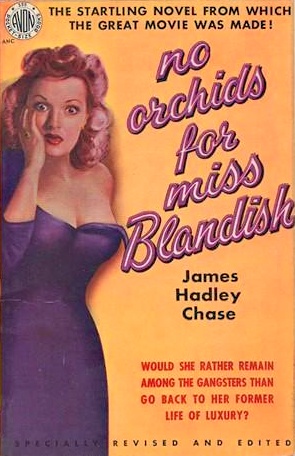
Forgotten Books: NO ORCHIDS FOR MISS BLANDISH by James Hadley Chase

To begin with, this title is absolutely correct. There are no orchids in this book for Miss Blandish or anyone else. I don’t believe there is even a mention of orchids, so if your name happens to be Nero Wolfe, I suggest you turn to another blog.

Otherwise, read on.

I’ve had a book bearing this title (the Avon “Classic Crime” edition of 1961) kicking around the house for years, but resisted reading it. Somehow I had learned it was a revised and toned-down version of the notorious original. I mean, if I’m going to read a book famous for its brutality, why settle for a watered-down version?

A couple of years ago, I got curious again and tried to learn if any of the many reprint editions contained the original 1939 text. And it just got more frustrating. Best I could learn was that it had been officially revised by Chase (aka Rene Brabazon Raymond) in 1942 and again in 1961, with numerous variants published in between. I tried to track down a genuine first edition through InterLibrary Loan, and failed that too.

So I continued not reading it, until finally—just last year---Stark House came out with an uncensored, unexpurgated version, featuring the original text.

Was it worth the wait?

Well, it was pretty dang interesting. Back in 1939, it was probably the most violent book ever published, and I can see why it raised a ruckus. By now, I’m sure it’s been surpassed many times, but not by anything I’ve read, or would care to read.

The basic plot is this: Miss Blandish (no name given), daughter of a really rich guy, is kidnapped by a gang of brutal thugs. Almost immediately, she is re-kidnapped by a gang of infinitely more brutal thugs. As you would expect, brutality ensues. This continues until a private detective—relatively brutal himself, but with redeeming senses of humor and honor—is hired to find her.

To give you an idea of the caliber of crook she’s dealing with, her chief tormentor, Slim Grisson, was once caught by his school master “cutting up a new-born kitten with a rusty pair of scissors.” Slim does everything violently, right down to way he picks his nose. Leading the gang is the kitten-cutter’s mother, who has “shoulders like a gorilla,” and flesh hanging “in two loose sacks on either side of her mouth.” On meeting Miss B, Ma says, “You’re going to stay here until your old man comes across” and “If he tries to be smart, I’m going to take you apart in bits, and those bits will be sent to your pa every goddam day until he learns to play ball.” And she ain’t fooling.


P.I. Dave Fenner, who makes his first appearance almost halfway into the book, knows how to deal with such folk. Switching on a portable electric stove, he watches the filaments turn red and says, “I could get a hell of a kick clappin’ this poultice on that’s rat’s mug.” And he ain’t fooling, either. Later he holds a fry pan full of hissing grease over another rat and announces, “You’ll talk or I’ll slop this fat in your mug.” The rat talks.

Chase delivers many nice turns of phrase. As in, “There was a dead man lying on the floor. There could be no mistake just how dead he was. The small blue hole in the centre of his forehead told Eddie that he was as dead as a lamb cutlet.”

The story is set in the U.S., and though Chase did pretty well with Americanese, a few British terms and spellings slipped through. Words like kerb, cheque, bell-push, boot (for trunk), grips (for suitcases) and lift (for elevator). At one point Fenner says, “It’s sweet fanny to me who happened to Heinie. That little rat’s got nothin’ to do with me.” Sweet fanny?

The afterword to the Stark House edition, by John Fraser, discusses the novel’s complex publishing history and probable sources. One insight of particular interest to me was the mention of Jonathan Latimer’s The Dead Don’t Care, published in England the year before Orchids. Fraser quotes a passage in which Crane ponders what happens to pretty women at the hands of kidnappers. Crane is pretty sure he knows, but wonders why no one ever talks about it. Fraser thinks this scene may have been in Chase’s mind when he came up with Orchids. According to Fraser, the original 1939 text appears in a 1977 Corgi paperback and and 1961 Robert Hale edition, both published in Great Britain. This new Stark House book (which also contains, you may have noticed, Twelve “Chinamen” and a Woman) appears to the first American printing of the real thing.


P.S. In case you missed it, over the past four days I’ve taken a nosy look at the bookshelf of author Stephen Mertz, featuring books by Cleve F. Adams, Michael Avallone, Robert Leslie Bellem, Carroll John Daly, Lester Dent, Donald Hamilton, Dashiell Hammett, Robert E. Howard, Joe Lansdale, Don Pendleton, Richard S. Prather, Bill Pronzini, Bob Randisi and others. You can view the whole shebang HERE.

Friday, April 19, 2013

Forgotten Books: COME EASY - GO EASY by James Hadley Chase

There’s nothing fancy about James Hadley Chase’s prose. The narrator of Come Easy - Go Easy tells his tale in simple I did this and she did that fashion. The strength here is in the story. While the simplicity of the prose keeps you moving in a straight line, the story sneaks up from behind and socks you over the head.

Our hero Chet Carson works for the Lawrence Safe Corp, making him an expert on opening safes. The loot the company’s clients put in their safes tempts him until he can no longer resist, and he plans a heist with good buddy and fellow safe-expert Roy. But the job goes sour, Roy kills a guy and scampers, leaving Chet holding the bag.

Unfortunately for Chet, he’s too loyal to finger Roy, so he’s sentenced to a long spell in prison. Finding conditions intolerable, he risks everything on an escape - and makes it. But as you can probably guess, his troubles are only beginning.

Chet finds himself a sweet place to hide - a backend of beyond service station in a place called Point of No Return, only to find himself intwined with a money-hungry woman and another Lawrence Safe full of loot. And, worst of all, his old “pal” Roy.

First published in the UK in 1960, Come Easy - Go Easy is now the first half of a JHC double from Stark House Press. I’m now looking forward to the second half!

More Forgotten Books at pattinase!