Showing posts with label Dell Mapbacks. Show all posts

Monday, March 30, 2015

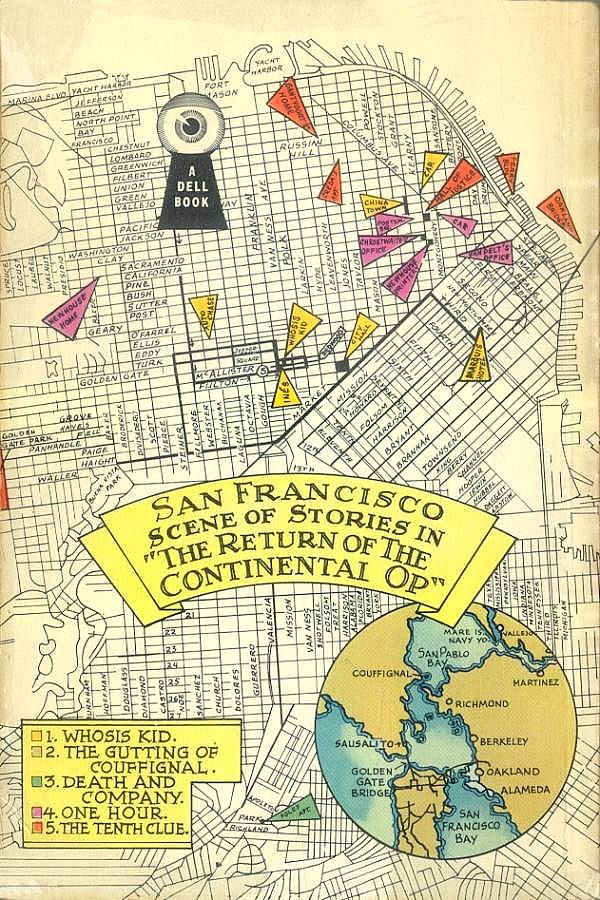
MAPPING the Continental Op


Back in the Olden Days (in this case prior to 1979) our best resource for following the footsteps of the Continental Op was this series of maps on the backs of Dell paperbacks. These days, of course, we have Don Herron's far more informative Dashiell Hammett Tour guidebook (details below), but these maps are still mighty cool to look at. The one above, from The Continental Op, even walks us through a couple of the stories.


This one is especially cool in that it locates the apparently fictional island of Couffignal. 


Half Moon Bay ("Halfmoon Bay" in the book), scene of the climactic events in "The Girl with the Silver Eyes," turns out to be a real place.


"The Green Elephant" and "The Hairy One" (originally titled "Ber-Bulu") in the collection Dead Yellow Women are not Op stories.
 

On the back of The Creeping Siamese, location 3 refers to "The Nails in Mr. Cayterer," one of Hammett's two stories featuring a poet named Robin Thin, and 4 is the site of another non-Op story, "The Joke on Eloise Morey." 


This map, from the second Dell edition of Blood Money, focuses mainly on locations (1 thru 6) in the first story, "The Big Knockover." 4 thru 10 involve the sequel, "$106,000 Blood Money."
 

The first Dell edition of Blood Money gives us a close up of the climax of "$106,000 Blood Money," in which the Op goes up against the folks behind "The Big Knockover."


Here, however, is the book every Hammett fan should own. Don Herron provides not only maps, but photos, facts, trivia, background and historical perspective on every important location in every Hammett tale taking place in the environs of San Francisco.

It's great if you're visiting the city, and equally great if you're not, because reading it is almost like being there.

You can get yours here:
The Dashiell Hammett Tour: Thirtieth Anniversary Guidebook (The Ace Performer Collection series)

Sunday, March 22, 2015

THE CONTINENTAL OP (1945, 1946) by Dashiell Hammett


Yeah, I have the Continental Op (and my new AHMM story "The Continental Opposite," previewed HERE) on the brain, so I'm presenting this encore performance of a Forgotten Book post from 2012. I'll present lots more Op stuff a the week rolls on.

The Continental Op has been used as the title of several collections, but the one we're talking about here is the original, published in digest in 1945 and paperback in 1946. This collection was one of many edited and compiled by Frederick Dannay (half of the Ellery Queen team) and Don Herron's frequent guest-blogger Terry Zobeck has demonstrated that Dannay altered the text of many of the stories.

The four tales in this book, however, appear to have largely escaped Dannay's heavy hand. The 2001 collection Hammett: Crime Stories & Other Writings contains the original Black Mask versions of all four stories, and while I didn't compare each tale word-for-word, I did some spot checks and failed to find any changes other than punctuation or spelling.

One of the most interesting aspects of the Continental Op series is the way it displays Hammett's growth as a writer. All 28 stories (and at least one of the two novels) are good, but the quality of Hammett's prose changes dramatically from the Op's first appearance in 1923 to the first installment of the Op masterpiece Red Harvest in 1927. 

In the beginning, Hammett's Op was practically an invisible man. He displayed no personality, and his matter-of-fact prose was designed to educate the reader on realistic investigative practices. But bit by bit, story by story, the Op's character begins to emerge.

Two of the stories in this collection, "Zigzags of Treachery" and "Death on Pine Street" (originally titled "Women, Politics and Murder"), were first published in 1924 and are transitional tales. The Op indulges himself with a wisecrack now and then, and we see Hammett stretching his writing muscles. A third story, "The Farewell Murder," did not appear in Black Mask until 1930, but was clearly written far earlier - most likely in 1923.

The beginning of the "The Farewell Murder" may have been inspired by an old vampire movie. It opens with a chauffeur driving the Op up a dark and winding road to the client's home. On the way they see a body in the road, which scares the heebie-jeebies out of the driver. When the Op goes to investigate, the chauffeur vanishes into the woods. The rest of the story involves men who did each other dirt in Egypt and have now brought their blood feud to the States. The Op uncovers a clever scheme by one of the feuders. 

"Zigzags of Treachery" is a peculiar combination of old and new. The first few pages are a monologue by the attorney/client involving some old time melodrama. The middle of the story displays some realistic detective work with only occasional bits of flavor. And the end is a monologue by the chief crook, explaining his part in the scheme. This time it's the Op who delivers the clever finish.

"Death on Pine Street" begins with a familiar problem - the murder of a philandering husband, but displays hints of the Op's wit, humor and capacity for violence. In the end he socks a guy purely for payback. And yeah, it's another clever ending.

But the highlight of the collection is "Fly Paper." This story appeared in Black Mask in 1929, after both Red Harvest and The Dain Curse, and shows the Op at his best. Every line of the narration is tight, tough and packed with wit. The story peers under the lid of the seamy underworld, into a complex plot that ends with a wild manhunt and shootout. Little wonder Lillian Hellman selected it for inclusion in The Big Knockover (where she subjected it to further, and more drastic, changes in punctuation).

These four stories are well worth your time, and can be found in other collections. What you won't find elsewhere is the introduction by "Ellery Queen." And that, too, is worth your time. So here it is:


Friday, January 4, 2013

Forgotten Books: The Creeping Siamese by Dashiell Hammett (1950)


Yep, I'm still on a Hammett binge, and still have several more books to yap about.

This one appeared in both digest and paperback in 1950.

The title story, which appeared in the March 1926 Black Mask without the "The" in front of it, is one of three tales featuring our short stocky hero, the Continental Op. In context of the story, the title makes more sense without the "The." As is, you might think someone is about to fall victim to a sneaky kitty-cat. Actually, the Siamese of the title are believed to be merciless knife-artists from Siam.

By the time Hammett wrote "Creeping Siamese" he already had twenty Op stories under his belt, so he was well in the groove. This is a fine little tale, with the added interest that it foreshadows still another scene from The Maltese Falcon. The story opens with a man entering the Continental Detective Agency office and dropping dead on the floor. In the course of the investigation, the Op is told that the dead man was recently in possession of a mysterious package, and that other mysterious characters were trying to take it away from him. The package is described as being about the size of a loaf of bread, but quite heavy for it's size. It's wrapped in brown paper, with an inner wrapping of canvas, and tied with a silk cord. Can you say dingus?

"The Man Who Killed Dan Odams," from Black Mask of January 15, 1924, is a shortie, and just about the closest Hammett ever came to writing a western. There's a jail and a marshal and a ranch of sorts, and our protagonist rides a horse. The only thing that prevents it being a western is a couple of mentions of automobiles.

"The Nails in Mr. Cayterer" (from Black Mask January 1926)  is another "lost" story that's been out of print since this appearance in 1950. Too bad, because it's a good story. This one introduces Robin Thin, the poet son (and sort-of partner) of a private investigator. Why is it out of print? Beats me. A second Robin Thin story, unpublished during Hammett's lifetime, debuted in EQMM in 1961, and now resides in the 1999 collection Nightmare Town.

"The Joke on Eloise Morey," from Brief Stories of June 1923, is the briefest story in the book, and relies on a single twist. It's a nice twist, though, and a nice little joke on Eloise.

"Tom, Dick, or Harry," from Black Mask October 1925 is pisser. Hammett went to great lengths to avoid cliches, and titled this story "Mike, Alec or Rufus," in a deliberate effort to get the benefit of the Tom, Dick or Harry idea without actually saying it. Then Frederic Dannay cane along and ruined it for him. I'll bet Hammett was pissed too. This is a minor Op tale, but still a good read if you can wipe the phony title from your brain.

The longest story in the book, and arguably the best, is "The King Business," an Op adventure that did not appear in Black Mask. Instead, it first appeared in Mystery Stories in January 1928, at the same time the Red Harvest novelettes were running in Mask. I have no inside dope on this, but wouldn't be surprised if Joe Shaw rejected it, feeling it delved too deep into European politics and strayed too far from the mean streets his readers were used to. Still, it's a fine story, with the Op up to his neck in revolutionaries, counterrevolutionaries and opportunists, with an idealist or two thrown in for flavor. The fictional kingdom of Muravia is a brutal place, and the Op gets a front row seat at a long and brutal whipping. EQMM commemorated the scene on their cover when they reprinted the story in 1949.

More amazing Forgotten Books at Sweet Freedom. More Hammett, most likely, coming next week.

Friday, December 21, 2012

Forgotten Books: Nightmare Town by Dashiell Hammett (1948, 1950)


The four-story collection Nightmare Town first appeared in digest in 1948, with stories edited by Frederic Dannay, and was repackaged in this nice Dell Mapback in 1950. As a bonus, the Mapback included seven original illustrations, shown below. Bill Lyles, in a Paperback Quarterly article, attributed the art to Lester Elliott, and Bill should know.

If the novelette “Nightmare Town,” originally from Argosy All-Story Weekly in 1924, had been written by Lester Dent, Walter Gibson or Norvell Page, I’d probably think it was a crackerjack story. But at Hammett’s hands, the tale seems unworthy of its author.

Without giving too much away, I can say that the plot involves crime on a grand scale - a scale so grand that it requires heaping helpings of suspension of disbelief, and cries out for purple prose. And that’s the problem, because Hammett’s prose is anything but purple, and when he tells me something’s happening, I tend to believe him.

Not this time.

The good news, though, is that “Nightmare Town” was his first crack at tackling a large scale crime, and can be viewed as a test run for the more successful stories to follow. I’m talking here about “The Gutting of Couffignal,” in which an entire town is looted, “This King Business,” in which a corrupt European nation is up for grabs, “The Big Knockover,” where a hundred of the nation’s elite crooks converge on San Francisco to rob two banks at once, and Red Harvest, where the Continental Op blows the lid off a crime-infested city.

Our hero here is Steve Threefall, who blunders into the strange town of Izzard on a drunken bet, takes interest in a nubile young woman, and is soon up to his neck in strange characters and sudden violence. Luckily, he carries a weighted ebony walking stick and knows how to use it. The stick is described as having a roughness that polishing cannot disguise - which must have confused the Dell artist, because he seems to have turned it into a club.

Steve Threefall kicks butt with his "walking stick."

Unlike the Op, Steve allows himself to fall for the dame.

Hammett’s prose is a pleasure to read, as always, and there’s plenty of action in the finale, but something is just . . . off. I have no evidence that he tried and failed to sell this to Black Mask before submitting it to Argosy All-Story, but I wouldn’t be surprised.

Next up is “The Scorched Face,” from Black Mask May 1925, in which the Continental Op is on the trail of two runaway rich girls. This one is a nice mix of realistic detective work with gratuitous sex and violence. Hammett was quickly learning his trade.

The artist didn't get the memo that the Op is supposed to be short and broad.

Still not broad, but maybe shorter.

“Albert Pastor at Home” is a short-short (little more than flash fiction) that first appeared in Esquire in 1933. It’s a great little tale, though, full of humor and tough talk. And it’s unusual for Hammett, because it’s told in first-person present tense.

Meet Albert Pastor (alias Lefty), a genial disbarred heavyweight
who beats people up for money (or for free).

This collection saved the best for last, as the Continental Op rides into the Wild West in “Corkscrew,” from Black Mask September 1925. Hammett had fun with this one and didn’t care who knew it. Corkscrew, like Izzard the Nightmare Town, and like the yet-to-come Poisonville of Red Harvest, is a corrupt town, and the Op decides to clean it up whether his clients like it or not. Hammett was following the example of many western films of the time (and later), in which six-gun toting, bronc-busting cowpokes co-exist with city-slickers driving automobiles. It's a hoot.

Never thought I'd see the Op in a cowboy hat.

This tussle began thusly:
The ex-pug looked me up and down and spit on the ground at my feet. 
"Ain't you a swell mornin' glory?" he snarled. I got a great mind to smack you down!"
"Go ahead," I invited him. "I don't mind skinning a knuckle on you."

These days, “Nightmare Town” is the lead story in the 1999 collection Nightmare Town. It also appears in Crime Stories and Other Writings (2001), along with “The Scorched Face.” For “Corkscrew,” you’ll have to look in The Big Knockover, which also includes the Dannay-edited version of “The Scorched Face.”


More Forgotten Books at pattinase!

Friday, December 7, 2012

Forgotten Books: Hammett Homicides (1946, 1948)


Hammett Homicides, edited by "Ellery Queen," appeared in digest in 1946 and Dell Mapback in 1948.

The stars of this collection are the two related novelettes “The House on Turk Street” and “The Girl with the Silver Eyes.” Originally from Black Mask in April and June 1924, this was the first time the two stories appeared together, and they’ve been together ever since.

Both stories are good examples of the Op in transition. He’s still behaving like a realistic agency detective, but his language is growing more colorful. He’s still a long way from the peak of his narrative style in Red Harvest, but he’s on the move.

In “The House on Turk Street” a kindly old couple agree to answer questions to aid his investigation. But they’re not at all what they seem, and the Op finds himself in a house full of thieves, each more dangerous than the next - and each looking for every opportunity to double-cross the others. One of the gang is a deadly dame who escapes to bedevil him again in the next story . . .

. . . “The Girl with the Silver Eyes.”  The deadly dame, known as Elvira in the first story, now uses the handle Jeanne Delano, but neither is her real name. She was Hammett’s first prototype for the character who eventually became Brigid O’Shaunessy in The Maltese Falcon. She relies on her beauty to bamboozle men, and she’s so good it almost works even on the Op.

Next up is “Night Shots,” a manor house mystery from February 1, 1924. The Op solves a clever plot, and the characters are quirky, but his language is pretty bland. Hammett made a major stylistic leap between this and “Silver Eyes,” just four months later.

The fourth, and last, Op story in the book is “The Main Death,” a puzzle story from June 1927. Publication-wise, it falls between “$106,000 Blood Money” and the first installment of Red Harvest, but stylistically it’s more akin to “Night Shots.” My guess is that this was written in 1923 or ‘24. It’s main claim to fame is that features a character named Bruno Gungen who bears several qualities later seen in Caspar Gutman.

“Two Sharp Knives” is an oddity - a first-person detective story in which the narrator is not the Op - he’s a small town police chief named Scott Anderson. This one appeared in Collier’s in January 1934, and it’s a nice little tale, though not among Hammett’s best.

“Ruffian’s Wife,” from the October 1925 issue of Sunset, was the biggest surprise for me. This is fine, sophisticated storytelling - and great prose too - though the entire story is in the third person point-of-view of the title character. I hadn’t read this in just about forever, and forgot how good it was.

So where do these tales reside today?  “The House in Turk Street,” “The Girl with the Silver Eyes” and "The Main Death" are in both The Continental Op (1974) and Crime Stories & Other Writings (2001). The Crime Stories versions follow the Black Mask text, while the others, like those in Hammett Homicides, were altered by Frederick Dannay. “Night Shots,” “Two Sharp Knives” and “Ruffian’s Wife” appear in Nightmare Town (1999).

Links to more Forgotten Books appear on pattinase.

Friday, November 2, 2012

Forgotten Books: The Continental Op (1945, 1946) by Dashiell Hammett


The Continental Op has been used as the title of several collections, but the one we're talking about here is the original, published in digest in 1945 and paperback in 1946. This collection was one of many edited and compiled by Frederick Dannay (half of the Ellery Queen team) and Don Herron's frequent guest-blogger Terry Zobeck has demonstrated that Dannay altered the text of many of the stories.

The four tales in this book, however, appear to have largely escaped Dannay's heavy hand. The 2001 collection Hammett: Crime Stories & Other Writings contains the original Black Mask versions of all four stories, and while I didn't compare each tale word-for-word, I did some spot checks and failed to find any changes other than punctuation or spelling.

One of the most interesting aspects of the Continental Op series is the way it displays Hammett's growth as a writer. All 28 stories (and at least one of the two novels) are good, but the quality of Hammett's prose changes dramatically from the Op's first appearance in 1923 to the first installment of the Op masterpiece Red Harvest in 1927. 

In the beginning, Hammett's Op was practically an invisible man. He displayed no personality, and his matter-of-fact prose was designed to educate the reader on realistic investigative practices. But bit by bit, story by story, the Op's character begins to emerge.

Two of the stories in this collection, "Zigzags of Treachery" and "Death on Pine Street" (originally titled "Women, Politics and Murder"), were first published in 1924 and are transitional tales. The Op indulges himself with a wisecrack now and then, and we see Hammett stretching his writing muscles. A third story, "The Farewell Murder," did not appear in Black Mask until 1930, but was clearly written far earlier - most likely in 1923.

The beginning of the "The Farewell Murder" may have been inspired by an old vampire movie. It opens with a chauffeur driving the Op up a dark and winding road to the client's home. On the way they see a body in the road, which scares the heebie-jeebies out of the driver. When the Op goes to investigate, the chauffeur vanishes into the woods. The rest of the story involves men who did each other dirt in Egypt and have now brought their blood feud to the States. The Op uncovers a clever scheme by one of the feuders. 

"Zigzags of Treachery" is a peculiar combination of old and new. The first few pages are a monologue by the attorney/client involving some old time melodrama. The middle of the story displays some realistic detective work with only occasional bits of flavor. And the end is a monologue by the chief crook, explaining his part in the scheme. This time it's the Op who delivers the clever finish.

"Death on Pine Street" begins with a familiar problem - the murder of a philandering husband, but displays hints of the Op's wit, humor and capacity for violence. In the end he socks a guy purely for payback. And yeah, it's another clever ending.

But the highlight of the collection is "Fly Paper." This story appeared in Black Mask in 1929, after both Red Harvest and The Dain Curse, and shows the Op at his best. Every line of the narration is tight, tough and packed with wit. The story peers under the lid of the seamy underworld, into a complex plot that ends with a wild manhunt and shootout. Little wonder Lillian Hellman selected it for inclusion in The Big Knockover (where she subjected it to further, and more drastic, changes in punctuation).

These four stories are well worth your time, and can be found in other collections. What you won't find elsewhere is the introduction by "Ellery Queen." And that, too, is worth your time. So here it is:


More Op stuff coming soon. More Forgotten Books right now at pattinase

Wednesday, March 30, 2011