Showing posts with label Carroll John Daly. Show all posts

Sunday, November 27, 2022

STEEGER BOOKS SALE, Day 3: More New ARGOSY LIBRARY Releases !!!


Day 3 (of 4) brings more good-lookin' additions to Steeger Books' ever-growing Argosy Library. I want 'em all. Top of the list today is Carroll John Daly's addition to the Hero Pulp genre. Mr. Strang is not a detective, he's a slightly-crazy vigilante driven to fight crime by a pesky bullet embedded near his brain, and he's every bit as ruthless as The Shadow and The Spider. 


Tomorrow, in the Cyber Monday Finale of this sale, BOWIE'S GOLD will make its bow, joining CROCKETT'S DEVIL on Steeger's list of titles. That will be your chance to pick up several copies of each (they'll make great Christmas presents) at 30% OFF - along with dang near every other new and old book offered at steegerbooks.com.


Friday, November 25, 2022

STEEGER BOOKS SALE, Day 1 !!!


Yeah, it's my favorite time of year (along with July), the Steeger Books/Altus Press annual Black Friday-Cyber Monday Sale. These ten brand new books debuted today, and many more (including one by me) will be unleashed upon the world over the next couple of days. All these, including the hundreds of great books already available, are 30% OFF during the sale. 

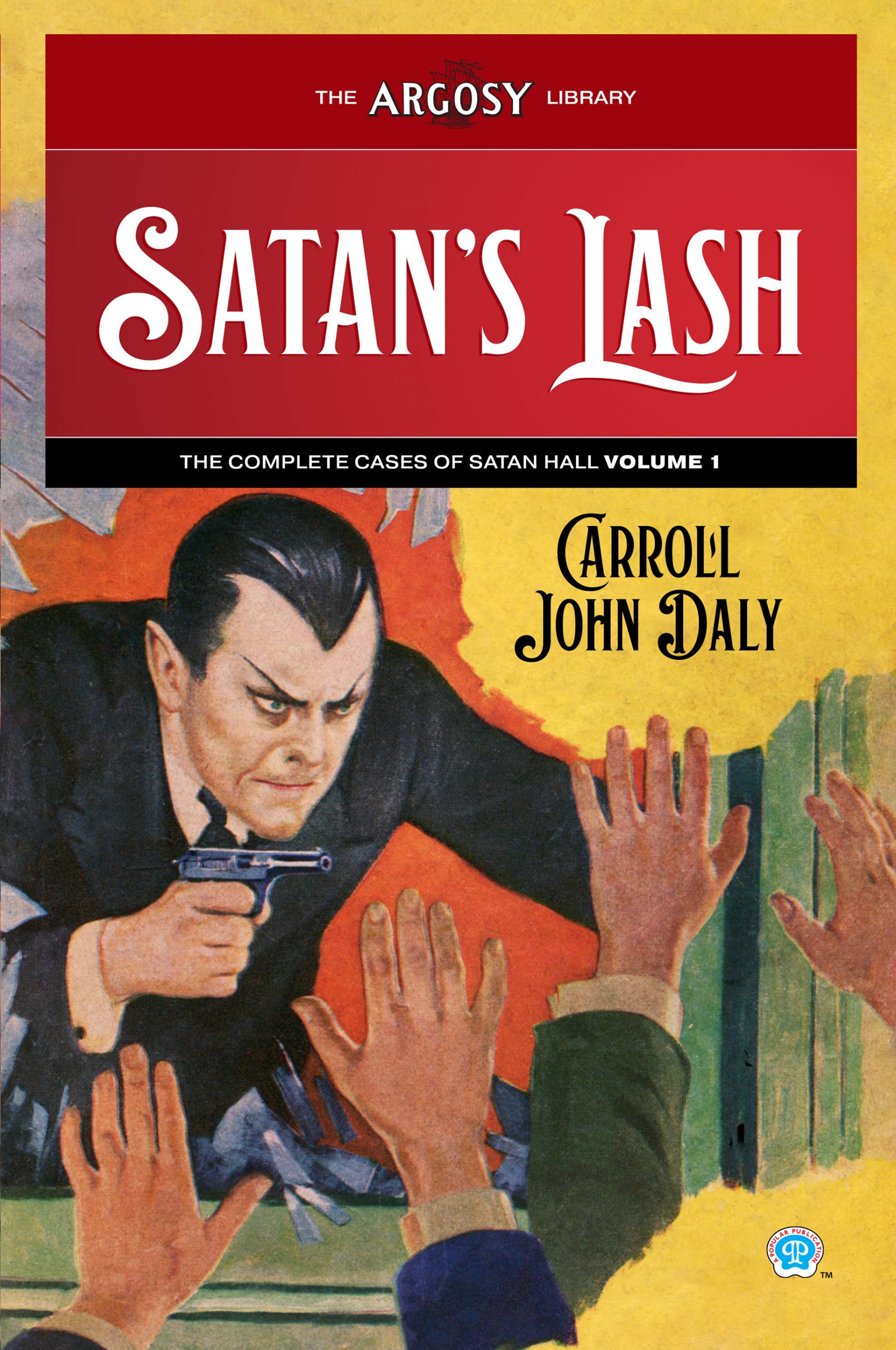
I'm especially stoked about his one, Volume 1 of the Complete Cases of Satan Hall, a guy who's even wilder than Race Williams! This volume includes Satan's very first adventure (heretofore unreprinted anywhere), thanks to the archeological efforts of famous author and pulp collector Stephen Mertz. Take a bow, Steve!

Stay tuned for more new books tomorrow. You can see the whole library at https://steegerbooks.com/.


Wednesday, September 9, 2020

SATAN HALL in "Satan Sees Red" by Carroll John Daly (1932)


Here's the setup for this cover from June 25, 1932: Satan is out to get a murderer named Bowers. Bowers has a classy nightclub, political influence and cops in his pocket. To intimidate visitors to his office, Bowers sits them under a hot light across from his desk. Satan pays Bowers a visit, making it clear he's carrying a rod but has no intention of using it - and sits in the chair under the light. Later, after things have escalated, Satan returns. Bowers now has reason to fear him. Before allowing Satan into his office, he takes away Satan's gun and places it in the open drawer of his desk. Bower's bodyguard remains in the room, keeping a gun on Satan. Here's what happens next:

Satan's hands dug deep down at his sides. His fingers seemed to clutch spasmodically at the heavy upholstery of the chair. At least, it seemed that way to Bowers, who couldn't see that far down from his desk . . . 

"You misunderstand me, Bowers. I'm not threatening to watch for an opportunity to kill you - hunt you down in some alley. When I say I'm going to kill you, I mean just that. On the open street - in the lobby of a hotel - at Forty-second Street and Broadway. In plain words, the first time I see you, no matter what the place. Even in this room here . . . That's why I came to see you. I wanted to let you know. It will be the first time I ever shot a man down in cold blood, but it's fact just the same. I'll give you time to talk - while I count ten."

Bowers draws Satan's gun from the desk and points it at his chest. Satan explains the gun is not loaded, then thrusts himself out of the chair. As Bowers claws at his armpit for his own rod, Satan shoots the bodyguard between the eyes and pistol whips Bowers across the face. Satan, you see, had stuffed a snub-nose revolver into the chair cushions on his earlier visit. And his real goal, rather than killing Bowers, was to make him burn in the electric chair.

This story was included in The Adventures of Satan Hall, published by Mysterious Press in 1988.

Saturday, September 5, 2020

RACE WILLIAMS and "Victim for Vengeance" by Carroll John Daly (1940)


This "Complete Novel" (35 pages of text and 3 pages of art) appeared in the September 1940 issue of Street & Smith's CLUES. In the context of Race Williams' career, it's pretty far down the line (his first story appeared in 1923), but chronologically, Race still has a long way to go. His last adventure was published in 1954.

As "Victim for Vengeance" begins, Race learns that a gunman known as the Admiral, whom he had previously run out of New York, is back in town. Worse, the Admiral is shooting his mouth off, saying Race is too yellow to come and get him. Race promptly disabuses him of that notion:


We'll, he'll certainly try. Race soon finds himself embroiled in a plot involving a Broadway starlet, a kidnapped child, the vengeful Admiral and a bashful gent known only as "John Smith." Can Race shoot himself out of trouble? What do you think?


P.S. You may also be interested in the Black Dog Books volume Race Williams' Double Date and Other Stories. These tales were selected by longtime Daly collector Stephen Mertz, and includes an illuminating foreward penned by Steve himself. In addition to five Race Williams stories, there's one featuring Daly's number two hero Satan Hall, one starring Doc Fay (the closest Daly came to a Christ figure), two other fine stories, and "The Ambulating Lady," in which Daly discusses the craft of writing. There are even a few words by me.

Friday, August 28, 2020

Forgotten Stories: "A Gift of the Gods" by Carroll John Daly (1923)


Back in January 1923, four months before Carroll John Daly introduced "Three Gun" Terry Mack, the first hardboiled private detective, "A Gift of the Gods" appeared in People's magazine. This is the earliest known (so far) adventure of a tough-talking kid named Chester Robinson, who appears to have been Daly's first series character. Chester's gutter English got Daly warmed up for the hardboiled narration of Terry Mack and (two weeks later) his longer-lived successor Race Williams. 

Chester himself moved to Argosy All-Story Weekly in March 1923, where he appeared in at least four more adventures, and possibly a couple more. My thanks to pulp historian Sai Shankar for pointing the way to these scans on the Internet Archive.


Friday, June 19, 2020

Forgotten Stoires: OUTSIDE OF TIME by Carroll John Daly (1950)


This is CJD's one and only appearance in Weird Tales, which seems like a very weird place for him to be.  It's from Jan. 1950, and comes to us courtesy of the Internet Archive.


Friday, March 27, 2020

Forgotten Books: THE WHITE CIRCLE by Carroll John Daly (1926)


I read this book again this week because I'm putting together an Introduction for a soon-to-be-published collection of Daly's Terry Mack stories for Steeger Books/Altus Press. It'll be one of a series of many devoted to the great series characters of Black Mask.

Last time I read The White Circle, nine years ago, I yapped about it here in Forgotten Books. Most of my thoughts were the same, and are repeated below, but I had a few new ones too. 

This book saw birth as a four-part serial called "The White Champion," beginning in the August 15, 1925 issue of Flynn's. It was Daly's third book-length work. The first, co-authored with C.C. Waddell, was the contemporary Western Two-Gun Gerta, which had been serialized in People's Story Magazine in 1923. This one came hard on the heels of Daly's first (I think) solo serial, "The Man With the Twisted Face," in July 1925 issues of Western Story

At the time, Race Williams was going strong in Black Mask, but because the editors did not like serials, Daly had to stretch his writing legs elsewhere. The first Race serial, "The Snarl of the Beast," did not run until 1927. 

"The White Champion" came from the same roots as Daly's earliest hardboiled writings for MaskOur hero here is a two-fisted, two-gunned adventurer named Stacey Lee who has traveled the world and sown his oats, finally settling down to a respectable life in the second echelon of New York society. The only difference between him and Daly's other early heroes (who made their living preying on criminals and blackmailers) is that he was for several years a success in the stock market. Then, as the story opens, he has lost that fortune. Facing ruin, he's about to skip town and revert to his old adventuring ways.

But, just in the nick of time, he’s approached by an old man calling himself The White Circle. The old man offers to restore Stacey’s riches if he agrees to don the white mask and do battle with the blackmailing scoundrel known as The Black Circle. Stacey agrees, and finds his old lifestyle has equipped him well to play masked avenger. 

I don’t know who the should get the credit for being fiction’s first masked do-gooder. Some folks say it’s the Scarlet Pimpernel, who was in the masked hero business as early as 1903. Zorro entered the ranks in 1919, and I’m guessing there were other modern-day crime fighters using the gimmick prior to 1926. I just haven't met any of them.

To add to the fun, Stacey is provided with a bunch of little White Circle stickers that he can paste one on the body of every bad guy he shoots. This sort of advertising gimmick, too, had been used by the Pimpernel and Zorro, but it's interesting to see Stacey employing it long before guys like The Phantom and The Spider. 

The mask worn by Daly’s hero in The White Circle is not described in detail, but I got the impression it either covers his whole head, or hangs down to completely conceal his face. The same can be said of the mask worn by the hero’s arch-villain, known as The Black Circle.

As is typical of Daly’s early work, the plot is creaky and melodramatic, and there are always curtains handy for someone, good or bad, to hide behind with a gun. But Daly’s prose was actually pretty good, except for his abominable habit of leaving thoughts and sentence unfinished, or loading his paragraphs with so many M-dashes that they became nearly incomprehensible.

Here’s the opening of the book, an example of Daly at his smoothest:

I went to sleep broke—as free from money as a bluefish is from wings. And I went to sleep sober, without a care or worry. It wasn’t in me to drown my sorrow. I felt none—when a man comes back, he fights his way—not slops it. My life had been chuck full of adventure: South America, the gay boulevards of Paris, the shining steel in the hand of a vicious Arab in that romantic, forbidden section of the old hillside city of Algiers. Even the deadly, biting stillness of the jungle night in the sweating tropical climate of Africa was not unfamiliar to me.

In New York I turned a little bank account into a fortune; the instinct to take chances made me in Wall Street, and that instinct wiped me out. There was no kick. For two years I had lived, but there was nothing of romance in the city—that uncertainty of lurking foes, that living, breathing closeness to death that had ever been in my nostrils. 

Not bad, eh?
But here’s a sample of the choppy stuff:

“Take off your coat,” I told him. “Sling it about your head—you know the house—is there a way down the back?—but lead, you must—I’d be lost out there.”

He nodded, his head wagging grotesquely through the haze—just a head, nothing more—the thick, seeping, clutching, stifling vapor pierced through the nostrils and into the base of the brain.

Coats over our heads—both at the door—Bert nearest the exit, we flung it open again. A burst of smoke again—a white, drifting wave that vanished almost at once—fire, just a raging fire—lay without, leaping from below—above the dark banister that guarded the stairs. 

I know one other die-hard Daly fan (his initials are S.M.) who finds this early stuff unreadable. Me, I enjoy it anyway, but I’m hard put not to whip out a pen and edit as I read.

Still, it's all good fun, and Daly brings it to a satisfying (if somewhat implausible) finish. Here's hoping the book will soon be on the reprint schedule of the very busy Mr. Matt Moring.