Showing posts with label Fantasy fiction. Show all posts

Friday, July 24, 2020

Forgotten Books: SWORDS AND DEVILTRY by Fritz Leiber (1970)


I first came across the adventures of Fafhrd and the Gray Mouser sometime in the early '70s, when in the throes of Howardmania. There were five volumes available back then, four story collections and one novel, and they were all good. So I finally decided to take another trip through the first book in the chronological series. And whaddaya know? Unlike the sword and sorcery works of Michael Moorcook, which now seem much less than they were, these stories are more.

Though they took place in a world similar to Howard's Hyborian Age, the tone of the stories is quite different. The characters are less brooding, more thoughtful, and generally have more fun. Leiber's style, while less poetic than Howard's, is more accomplished, and more complex. It makes you pay close attention, but is worth the effort. 

The series has a weird and complicated history. Created sometime in the '30s by Leiber's college roommate, Fafhrd the northern barbarian and the Mouser, the cunning ex-apprentice of a wizard, made their debut in the pulp magazine Unknown in 1939. After a few more Unknown stories in the '40s, they appeared in a couple other mags in the early '50s, then took a break until the Gnome Press collection Two Sought Adventure was published in 1957. This brought a resurgence, and they made the jump to the digest mag Fantastic, which became their home in the '60s. By 1970, there were the five volumes I mentioned earlier, with a sixth following in 1977 and a seventh in 1988. 

This first book contains three novelettes. First we meet young Fafhrd in his homeland and discover why and how he leaves. Then the wizardling Mouser, then called "Mouse," as he avenges the murder of his wizard. Finally, the two meet my chance in the dark city of Lankhmar, and begin their long partnership in crime and adventure.

The whole series is now available in ebook form, which I'll likely take advantage of. Some of my old pbs, nostalgic as they are, have cracked spines, deep, shadowy gutters and type smaller than my old eyes like. 


Friday, June 19, 2020

Forgotten Stoires: OUTSIDE OF TIME by Carroll John Daly (1950)


This is CJD's one and only appearance in Weird Tales, which seems like a very weird place for him to be.  It's from Jan. 1950, and comes to us courtesy of the Internet Archive.


Sunday, March 10, 2019

Otto Penzler Auction Results: FANTASY AND SCIENCE FICTION

$22,500

$5,750

$4,750 Third edition Frankenstein

$812.50

$1,000

$42,500 for concept art, designs and storyboards from an unproduced film version of Dune planned by Alejandro Jodorowsky

$2,000

$937.50

$1,750

$1,375

$4,000

$2,375

$1,500

$1,375

Okay, this isn't Fantasy or SciFi, but I didn't know where else to put it. This "Moo-Reese" Tabletop Cow by Maurice Sendak sold for $93,750. I want it so I can sell it and buy books instead.

Friday, February 8, 2019

Forgotten Books: CONAN OF VENARIUM by Harry Turtledove (2003)

Between 1982 and 1997 Tor published more than forty original Conan novels by a gang of various authors. Then, for no good reason I could see, they stopped short, dribbling out this final volume in 2003. I bought them all, and many still wait to be read. But I've always been especially curious about this one, and its time finally came.

Near as I can tell, Conan of Venarium is the earliest account of our favorite barbarian's life. He's twelve when the story starts, and fourteen (or possibly fifteen) by the time it ends. And I'm pleased to report I enjoyed the whole journey. 

One reason I liked this book so much was the almost complete lack of supernatural nonsense. There are no sorcerors, no Lovecraftian gods, no giant snakes, and no monster apes. After all these years of Conan reading, the Hyborian Age has become as real to me as any other age of history, and the fantasy elements are no longer necessary. In other words, I like the Sword stuff, but can do without the Sorcery. In this case, in a book that's 369 pages long, the magic begins on page 60 and exits and page 65. And that's a good thing.

As the title implies, this is the story leading up to - and the aftermath of - Conan's first great battle, the fabled battle of Venarium. It begins with the Aquilonian army winning its first battle on Cimmerian soil and attempting to establish a colony. The victors, whose army includes Bossonian archers and pikemen from Gunderland, build Fort Venarium, and station outposts of troops in villages like Conan's hometown of Duthil.

Two of the main point-of-view characters hail from Gunderland. One is  a brave and sturdy farmer, eager for the opportunity to own his own land, and the other an admirable soldier posted near Duthil.  Both interact to some extent with young Conan and other Cimmerians, and both are sympathetic characters.

r
The villain of the piece is Count Sterac, an Aquilonian nobleman who's been banished to the hinterlands because of his lascivious behavior with young girls. He's roundly hated by everyone on both sides, but too powerful to challenge.

After their first defeat, the Cimmerians are biding their time, rebuilding their strength and itching for an uprising. Conan, of course, is in a big sweat to kill all the invaders, and even at twelve he's bigger and stronger than most adults. But the Aquilonians have sworn to kill ten Cimmerians for every Aquilonian death, so Conan has to grit his teeth and wait. The wait lasts two years, while more settles pour in, and Venarium grows from a fort into a town. 

One of the books most interesting angles is the depiction of Conan's parents. In an exceptionally clever move, Turtledove gave Conan the same family dynamic as REH himself. Conan's big strong father Modrec is clearly based on Dr. Isaac Howard, and his mother Verina is a Cimmerian version of Robert's possessive and controlling mother Hester. 

Verina uses her ill health like a weapon against Modrec, who spends as much time as can away from home. Conan, meanwhile, dotes on her, and his father's absence only tightens the bond between them. When Conan is asked to spend a few days away, tending a neighbor's sheep, the boy hesitates. "Will Mother be all right with just you here to take care of her?" Those words could have come right out of REH's mouth. Later, Verina tells Conan the girl he desires is a hussy and not good enough for him. Shades of Novalyne Price.

The suicide issue is hinted at when Verina's health declines, and Modrec worries what will happen when she dies. How long could she go on? he thinks. How could he go on - and esecially, how could Conan go on - when she lost her protracted struggle with mortality? When she finally dies, Conan's response is, "After today, with my mother dead, what care I if I live or die?"

Thankfully, that's as far as it goes. To see Conan lop off his own head in his first adventure would be a bit hard to swallow.  Instead, he lives to wreak vengeance on the Aquilonians. 

I have to wonder where the names Modrec, Verina and Duthil. Were they mentioned by someone sometime earlier in the Conan saga, or did Turtledove just make them up? Anyone know?

Here's something else I'm curious about. This, I believe, was the last mass market paperback I bought new, and the cover price was $6.99. And that was sixteen years ago! Jeez, if they cost that much then, how much are they going for now??

Friday, January 11, 2019

Best-Forgotten Books: THE EYE OF THE WORLD by Robert Jordan (1990)

The good news first: Half of The Eye of the World is a pretty good book.

Now the bad news: The other half is mindless blather, and the only way to separate the good from bad would be to take a red pencil and cross out all the crap. 

This came as a surprise to me, because I read this and several sequels back in the '90s, and remember liking them. I quit only because I was all caught up, and didn't want to wait for the next book. And that concerns me. I mean, that was only twenty-some years ago. Was my taste really that bad?

Anyway, I reread several of Robert Jordan's Conan books last year, and found them so good I read two and three in a row. The prose was rich but tight, and the characters fun to be with. Each was a little longer than the average Conan pastiche, but seemed just the right length for the story. Every word counted. 

So I was looking forward to a return visit to The Wheel of Time series. Now finished at last (with help from Brandon Sanderson), the series runs fourteen books, plus a few extras. I figured the audiobook versions would give me years of entertainment.

Alas and alack, that was not to be. The Robert Jordan who wrote The Eye of the World (real name James Oliver Rigney, Jr., Wikipedia tells me) seems to be whole different guy from the one who did those Conan books. Rather than the adult fantasy I expected, this book reads like Young Adult. Everything has been dumbed down to a level that borders on Juvenile. 

There are many long and dreary dream sequences (never a good sign) and many stories told of former ages, all of which are more intersting than the main story (another bad sign). 

Of course, Jordan was not trying to make this Conan-like. He was trying to rewrite The Lord of the Rings. The story itself is pretty good, and the characters (aside from the snot-nosed Young Adults) are interesting. But the prose is bland and boring, and dang near every scene is twice as long as it should be. Many scenes containing two or three minutes of meaningful story were stretched out to twenty minutes by tedious and repetitive inner dialogue. 

I found this maddening, and there were many, many places along the way where I nearly chucked the whole thing. But I figured if I didn't finish it now, and give the series a chance, I never would. So I stuck it, suffering through almost 30 hours of this sucker, to see if the payoff was worth it. 

As I'm sure you've guessed by now, it wasn't. The big finale was as bloated as everything leading up to it, and left me cold. Too bad. As I said up front, half of this book was pretty good, and if cut to half (or maybe a third) of the length, I probably would have liked it. I could see this as a decent TV mini-seiries, or maybe a graphic novel. But as a 30-hour audiobook I give it three thumbs down. 

So now it's decision time. Do I listen to another 400 hours of this stuff, or puncture both eardrums with an icepick? Both sound equally appealing. 

Friday, October 19, 2018

Forgotten Books: CONAN THE MAGNIFICENT by Robert Jordan (1984)


Every time I finish one of Robert Jordan's Conan books, I'm eager to start another. In fact, it's hard not to, because if I try reading something different I have a tough time getting into it. 

Is that a good thing or a bad thing? A little of both, I suppose. Good for Jordan (or his estate), but bad for every other author, living or dead.

I read all six Jordan books (plus his adaptation of the Conan the Destroyer flick) as they first came out, and this is my second trip through. And they're still damn good.

This one surprised me a bit because it jumps out of the chronology established in the first three entries, Conan the Invincible (HERE), Conan the Defender (HERE) and Conan the Unconquered, and returns to his day's as a thief in Shadizar - before Invincible


Jumping around to different points in Conan's life is a time-honored practice, of course, started by REH himself, but I was expecting continuity and didn't get it. 


Anyway, it's all very fine, with two minor quibbles. First, Conan is described as being young, but doesn't act young. He's every bit as clever and world-wise as he is in anyone else's 
pastiches taking place later in his career, and far more thoughtful than the teenage barbarian of "The Tower of the Elephant," set not long before.

My other quibble is the similarity to Jordan's first Conan book, Invincible. Like that one, Magnficient proceeds from Shadizar to the desert, where our hero falls in with a band led by a proud and beauteous female warrior who can't resist him but hates herself for it. In both cases, despite restistance from her loyal followers, Conan - due to his superior mind and fighting ability - assumes defacto leadership of the bands. In both cases, too, a sorceror with a dastardly plan is tracking them from afar. 


But there are plenty of differences as well, and it's still a damn good read. 

I have two more Jordan's (plus the movie adaptation) awaiting me, after which I'll have to decide if I'm ready for another run at The Wheel of Time series. I read the first four or five way back when, but had to wait so long for the next one that I never went back, and swore off reading fantasy series until all the books were written. (Alas, I broke that oath with the Game of Thrones books, and got caught in the same trap.) Anyway, the series is now complete, but comprises fourteen volumes and a prequel. Do I really want to commit to fifteen big fat fantasy novels, with everything else I have on my plate? Woe is me. I just don't know.


Friday, August 17, 2018

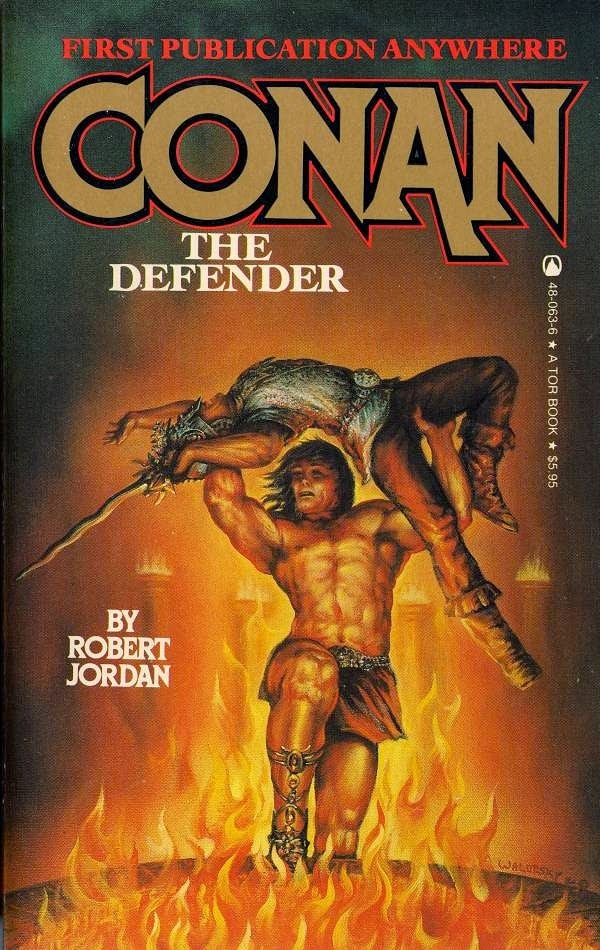
Forgotten Books: CONAN THE DEFENDER by Robert Jordan (1982)


After picking up The Further Chronicles of Conan at Goodwill recently, containing Robert Jordan's fourth, fifth and final Conan novels, I decided to go back and reread the first two. (I read all six back in the '80s, so for some this is the third time through.)

I jabbered about the first novel, Conan the Invincible, a couple of years ago (HERE), so it's now time to say a few words about the second.

Conan the Defender takes place a year or two after Invincible, and involves two Jordan creations introduced in the first book. Most important is Hordo, a one-eyed former bandit chieftan who's now involved with a smuggling ring. In this book, he ably fills the role of Conan's sidekick and drinking buddy. The other returnee is a flame-haired she-devil named Karela, formerly known as the notorious bandit leader The Red Hawk. She, too, is a good character, but that's all I'm going to tell you about her, because to say more would be a SPOILER. 

Conan, a thief in the fist book, has graduated to mercenary, and has set his sites on forming his own Free Company (which is a whole band of mercenaries). He's left Shadizar behind, and now has just arrived in Belverus, capital of Nemedia. As usual, there are several nubile maidens on hand, and the obligatory evil sorceror dabbling with forces beyond his control. Of greater interest, there's a plot to usurp the throne of Nemedia from an unpopular king.

Robert Jordan made no attempt to ape Howard's style. Instead, he created his own, which lacks the poetry and rhythm of REH, but still has its charms. His Conan is more thoughtful, a bit more scrupulous, and has a wider-ranging sense of humor. He'd be a good guy to go carousing with. Finishing one of these books makes me want to start right in on the next, which is as it should be. 

Strange to say, parts of this story seem somewhat dated, a problem I never encountered in the Howard stories published sixty years earlier. How did this happen? Well, as part of the plot to overthrow the king, the conspirators stir up unrest among the city's artists, poets and free-thinkers. This little band of radicals believes in the power of peace and love, and hopes to bring about politcal change without tarnishing their ideals with violence. How quaint. That may have reflected the climate when this book was published in 1982, but if it were written today the protestors would be wearing masks and helmets, and throwing bottles at the City Guard.

Friday, August 18, 2017

Forgotten Books: THE GUNSLINGER by Stephen King (1981)


Well, that was an experience. I read The Stand a long time ago, and probably another King or two, but I remember his writing being sort of normal. Disgustingly good, but normal. The Gunslinger isn’t. It’s wonderful and horrible, captivating and boring, meaningful and incomprehensible.

I picked up the first two Dark Tower books about ten years ago, read maybe twenty pages and put them in a box, never to be seen again. But when I went to see Wonder Woman a few weeks back, I saw the trailer for the new Gunslinger film, and figured I should give it another go. So I did.


Did I enjoy it? You can probably guess the answer to that one. Yes and no. Will I read the next in the series? Yeah, absolutely. I won’t be able to help myself.

Partly, that’s due to King’s writing. His sentences are like no one else’s, and at times he strings them into prose poems that make me feel like my head is about to spin off. Sometimes, I suspect, he gets so carried away his own head spins off, and the meaning is lost in the clouds, but it’s so well written I don’t really care.

It’s also due to the fact this is so totally unlike anything I’ve read before. A steady diet of normal works just fine for me, but it's probably good to shake up my brain once in a while.


I’m not going to tell you what this book is about, because that would ruin it for you. It’s not really a story so much as a voyage of discovery. You start out wondering what the hell is going on, and very gradually, mostly in flashbacks, you get some of the answers. And a lot more questions.

In the lengthy introduction to this revised edition (yes, he revised the novel in 2003, adding about nine thousand words and making who knows how many changes), King reveals what inspired it. The short answer is The Lord of the Rings and The Good, The Bad and The Ugly. That’s all you need to know, and all you really want to know, before starting.


King is famous for his method of writing by the seat of his pants. He writes to see where the story takes him. Sometimes it takes him to great heights, while at others he seems lost (like the gunslinger himself) in the desert or under a mountain, waiting for something interesting to happen. The novel’s saving grace is that when something interesting does happen, it really happens

The worst part, for me, was a long stretch in the dark—so long even the characters lost track of time—that reminded me of one of my least favorite books, Rex Stout’s Under the Andes (unfavorably reviewed HERE). It also didn’t help that there’s a whiny, snot-nosed kid in it. Whiny, snot-nosed kids should be banned from fiction. Forever.


I’m curious to see how this will work on screen. A good screenwriter can probably patch together enough scenes to resemble a story. At least there’ll be plenty of shooting.

There are seven numbered volumes in The Dark Tower series and an eighth that slips in between. If I read them all, will everything make sense? Can my brain take that much shaking up? Will my head spin off before I make it to book III? Alas, more questions than answers.


I believe most of the artwork shown here, by Michael Whelan, is from the 1981 first edition, now commanding five or six hundred bucks on eBay. One of these pics is from the cover of the third edition, and another was the basis of the cover for first trade paperback. I own none of the above. Along with my lost-in-a-box later pb, I have only an ebook.