John Carter made his first comic book appearance in The Funnies #30, back in 1939. The art is credited to Jim Gary. I found it on ComicBookPlus a year or two ago, but it has since been removed, no doubt due to copyright issues. Issue 31 was not there, nor was 33, but I was able to snag 32 and 34, so I have only snapshots of the early part of the story. We'll likely see the others somewhere down the Almanack Trail.
Showing posts with label Edgar Rice Burroughs. Show all posts
Tuesday, August 10, 2021
Friday, March 19, 2021
Friday, January 31, 2020
Unforgettable Books: TARZAN, CONQUEROR OF MARS by Will Murray
This is it: The most eagerly
awaited team-up of all time. The Lord of the Jungle meets the Warlord
of Mars!
I’m
not going to tell you tell you how that
meeting comes about –
or what sort of ruckus
erupts when it does – but I’ll tell you this: It was well worth
the wait. I found Tarzan,
Conqueror of Mars
faithful in every way to the spirit and tradition of Edgar Rice
Burroughs, and a thoroughly entertaining adventure.
I
have only one complaint. After 437 pages, it ended. I wanted the
story to go on and on.
Having proven his ability to channel Lester Dent in the Wild Adventures of Doc Savage, Will Murray demonstrates he’s also up to filling the dusty boots of Edgar Rice Burroughs.
I was impressed with his deft handling of both main characters. Tarzan is as fierce as ever, half-savage and half-civilized, and loyal to Jane and all who depend on him. John Carter is proud, fair-minded, considerate, and a great strategist. Both, of course, are self-sacrificing and utterly fearless. To add to the authenticity, Tarzan’s point of view is narrated in third person, while John Carter’s is in first, just like the Burroughs’ books.
In
typical Burroughs fashion, Tarzan finds himself mysteriously
transported to Barsoom, and sets about dealing with his strange new
environment. He encounters beasts, peoples and circumstances wholly
outside his experience, and – in typical Tarzan fashion – makes
himself master of this new domain. He turns enemies into allies and
embarks on an unrelenting quest to find his way back to home and
family.
Along
the way, there are typically ferocious battles, cool plot twists and a
host of engaging characters – both old and new. For those of us
who’ve read both the Tarzan and Mars series, this is a joyous
reunion with many of the characters and concepts we’ve come to
love. For those acquainted only with Tarzan, it’s a great
introduction to the world of Barsoom, opening up a whole new world of
adventure.
The
battle scenes are all nicely handled, and one in particular was so
good it made me want to stand up and cheer.
It’s
rare these days for me to find a book I don’t want to put down, but
this one was exactly that. The narrative drive kept me turning those
pages until my eyeballs gave out, and left me eager to start again.
Bravo,
Mr. Murray! Tarzan,
Conqueror of Mars
is an instant classic.
Thursday, January 3, 2019
Thursday, November 1, 2018
Richard Powers' TARZAN Paintings (1960s)
The Return of Tarzan
Tarzan and the Ant Men
Tarzan and the Forbidden City
Tarzan and the City of Gold
Tarzan the Magnificent
Thursday, July 19, 2018
Tuesday, January 2, 2018
Tarzan of the Movies 6: TARZAN AND THE GOLDEN LION (1927)
James Pierce, the screen's fourth Lord of the Jungle, was chosen for the role by ERB himself, who met him at a party. The following year, Pierce married Burrough's daughter Joan, and the couple went on to play Tarzan and Jane on the radio. This film also features Boris Karloff as a traitorous native chief.
Wednesday, October 11, 2017
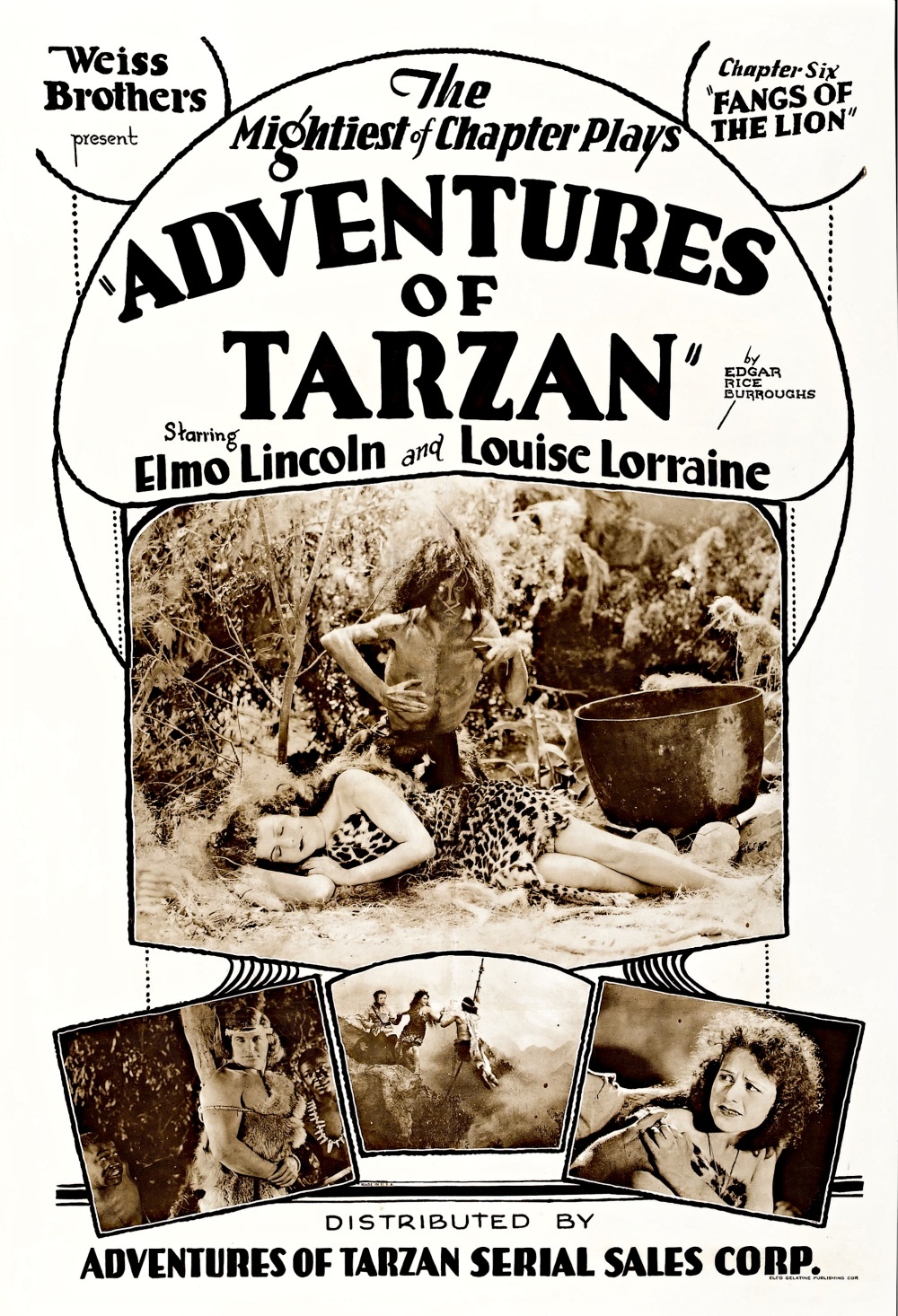
Tarzan of the Movies 5: THE ADVENTURES OF TARZAN (1921)
The first screen Tarzan returned in 1921 for this third and final appearance. Original a 15-chapter silent serial, it was later edited and rereleased in ten chapters with added sound effects. The original version is lost, but a reconstructed 10-chapter edition is now available from the film warriors of the Serial Squadron. This one took up where the previous film, The Revenge of Tarzan, left off, covering the final chapters of The Return of Tarzan and moving into Tarzan and the Jewels of Opar.
Sunday, September 17, 2017
Tarzan of the Movies 4: THE SON OF TARZAN (1920)
After rereading and reviewing this fourth novel in the Tarzan series (that's HERE), I decided to poke around and see what Hollywood had done with the book. This is it - a 15-chapter serial made way back in 1920, when the story was only four years old.
I haven't seen this one, so I'll just be looking at what posters and pics I can find, and make guesses about how they relate to the book.
Our story begins on Jungle Island, off the coast of Africa, where nudity is apparently acceptable.
This geek, I assume, is Alexis Paulvitch, second-banana villain of The Beasts of Tarzan, who, due to his evil deeds in that tale, was stranded on the island for ten years. The actor in the ape suit, I assume, is playing Akut, who's been missing his pal Tarzan for lo, these many years.
Akut is mighty smart ape, so Paulvitch takes him to London for a stage show. But Paulvitch, by nature a mean S.O.B., is no pleasure to work for.
Cut to stately Greystoke Manor, where ten-year-old Jack Clayton has been kept in the dark about his pop's ape man days. Jack is strangely obsessed with all things African and anthropoid. Denied permission to see the Akut show, he sneaks out and goes anyway.
Paulvitch acts up one too many times, and Akut kills him. Jack decides to escort Akut back to Africa. On the ship, Akut kills another evil human. I'm not sure which killing this poster portrays, but the result is that Jack is stranded in Africa with no money and no I.D.
Jack eventually goes native and changes his name to Korak, which is apese for "Killer." Enter Meriem, stolen when very young from her French aristocrat father by an evil Sheik. After years of torment, Korak spirits her away to a life of fun and games with his pal Akut.
In the book, Korak becomes sexually aware when Meriem is kidnapped by a bull ape with a gleam in his eye. After kicking the ape's butt, Korak gets a similar gleam. Meriem, though, is still too young for that birds-and-bees stuff. Apparently our movie Meriem blooms sooner.
So, unlike the young couple in the book, their movie counterparts begin a jungle romance.
But - and you had to know this was coming - Meriem is snatched by evildoers, and after being rescued from a couple of fates-worse-than-death, she ends up as a guest on the Greystoke Ranch. Poor Korak believes her dead until he spots her out riding with a snooty English dude. In the book, our pure-hearted hero realizes that a now-sophisticated babe like her could never go for a dirty ape man like him, and resolves to help her find happiness with her new (apparent) love. Not so in the movie, where hatred fills his heart.
In the book, the unlucky gent at left would likely be the evil hunter who has those fate-worse-than-death designs on Meriem. But because the movie takes place in a parallel African universe, it might just as easily be her horse-riding partner.
This scene is straight out of the book, and was considered important enough to grace the dust jacket of the first edition (see that HERE). The evil Sheik returns to cause more trouble, catches Korak, and plans to burn him at the stake. Luckily, Tantor the elephant storms in, yanks the stake out of the ground and carries Korak away. Unluckily, Tantor is too dumb to free him, and too pig-headed to allow anyone else to do it, so the junior ape man is carted around for a couple more chapters until Tarzan saves the day.
Tarzan, in his third big-screen appearance, is portrayed by a guy in a bad wig named P. Dempsey Tabler. He soon retired from acting and made a fortune in the advertising business.
Korak, in this first big-screen appearance is portrayed (in adult form) by Hawaiian actor Kamuela C. Searle. Legend has it that Searle died during the filming of Chapter 15, when the elephant dropped the stake and crushed him to death. That tale may be slightly exaggerated, since Searle was uncrushed enough to make a film the following year for Cecille B. DeMille. Searle's brother insisted he died of cancer in 1924.
Subscribe to:
Posts (Atom)