I first came across the adventures of Fafhrd and the Gray Mouser sometime in the early '70s, when in the throes of Howardmania. There were five volumes available back then, four story collections and one novel, and they were all good. So I finally decided to take another trip through the first book in the chronological series. And whaddaya know? Unlike the sword and sorcery works of Michael Moorcook, which now seem much less than they were, these stories are more. Though they took place in a world similar to Howard's Hyborian Age, the tone of the stories is quite different. The characters are less brooding, more thoughtful, and generally have more fun. Leiber's style, while less poetic than Howard's, is more accomplished, and more complex. It makes you pay close attention, but is worth the effort. The series has a weird and complicated history. Created sometime in the '30s by Leiber's college roommate, Fafhrd the northern barbarian and the Mouser, the cunning ex-apprentice of a wizard, made their debut in the pulp magazine Unknown in 1939. After a few more Unknown stories in the '40s, they appeared in a couple other mags in the early '50s, then took a break until the Gnome Press collection Two Sought Adventure was published in 1957. This brought a resurgence, and they made the jump to the digest mag Fantastic, which became their home in the '60s. By 1970, there were the five volumes I mentioned earlier, with a sixth following in 1977 and a seventh in 1988. This first book contains three novelettes. First we meet young Fafhrd in his homeland and discover why and how he leaves. Then the wizardling Mouser, then called "Mouse," as he avenges the murder of his wizard. Finally, the two meet my chance in the dark city of Lankhmar, and begin their long partnership in crime and adventure. The whole series is now available in ebook form, which I'll likely take advantage of. Some of my old pbs, nostalgic as they are, have cracked spines, deep, shadowy gutters and type smaller than my old eyes like.
I watched this show (most likely all of it) when it ran for three season between 1985 and 1988. Memory tells me it was fairly high-quality TV private eye fare, up there with The Rockford Files and Magnum, P.I.. You know what I mean. Good, but not exceptional. Nowhere near as good as the books, still a bit above average. Well, I just watched an episode, for the first time since 1988 - on IMDbTV - and found my memory had served me well. It was exactly that, and nothing more. Still, to Parker fans, especially uberfans like me, it has its attractions. (Want to watch it on IMDbTV? I'll tell you how down below.) I'm basing this on a single episode, mind you, the first official episode of Season 1, called "No Room at the Inn," but I expect it will be no more or less special than the 63 episodes to follow. I'll be watching some of them, and if I'm wrong you'll hear about it. The casting is OK. Robert Urich (as Spenser) could be a little bigger, Susan Silverman could be little more Jewish, Quirk could be taller and Belson could be seedier, but they're pretty much par for the course. The only gem in the cast is Avery Brooks as Hawk (You may know him as Capt. Benjamin Sikso from Star Trek: Deep Space Nine). He's right on target, and deserving of his own show, which he got - briefly - in the 13 episode spin-off A Man Called Hawk in 1989. The story was acceptable, the setting was good (some filming was done in Boston and some in L.A.) and the character relationships were about right. The only real problem is Spenser's dialogue - and, as an extension of that - his narration. Unlike Ace Atkins, who's doing a fine job on the current novels, the writer had no feel for Parker's humor. It's standard TV stuff, with none of the Spenser sparkle.
There was one nice Inside Baseball moment. Spenser goes into a building to question a desk clerk, and the guy is reading a paperback copy of Wilderness. That was Parker's first non-Spenser novel, I believe, and one that's dang near forgotten today. The three TV movies made between 1999 and 2001 with Joe Mantegna fared better, no doubt because Parker was directly involved. Mantegna was also narrating the audiobooks produced at the time, and had a good feel for the character. Now, you're no doubt aware, there's a Netflix movie called Spenser Confidential with Mark Wahlberg in the title role. Since I'm too cheap for Netflix, I don't expect to see it for a while, and have no idea what to expect. It's based on an Ace Atkins novel, though, so if there's enough of Ace's Parker voice in it, it could be good. IMDbTV, I recently discovered, is a free streaming service piggy-backed on the IMDb website. IMDb has info on everything, of course, but they now have a growing number of films and TV shows you can watch right on their site. This is one of them. But it's a little tricky. Here's how: After you've signed up for a free IMDbTV account, search for the show, and look for the big yellow tab that says "Watch Free on IMDbTV."
That should bring up a list of episodes. After a brief delay, links should appear beneath each available episode, reading, again, (in tiny type) "Watch Free on IMDbTV." You'll note there is no link beneath the pilot episode, "Promised Land," so that one is presumably not available. But there is one beneath the first regular episode, "No Room at the Inn," and beneath every other episode in Season 1. Click one of those links, and it should start the show.
Give it a try. Once past the initial user-unfriendliness, it works great.
Beginning in 1934, many of Hammett's novelettes and stories began to appear in serialized form in various newspapers. Sometimes the stories were given new titles, sometimes not. "Girl Hunt" is a retitling of "Fly Paper," which originally appeared in the August 1929 issue of Black Mask. These examples are from The Pittsburgh Sun-Telegraph of June 1936 and The St. Louis Post-Dispatch from July 1936. They're presented here to give you a look at the artwork, which was original to the serialization. In some of the Op stories, our hero was billed as "Continental Operative No. 7." Why that 7 was deemed necessary is too many for me. If you want to read the story (and you should, because stylistically it's one of Hammett's best) you'll find Frederic Dannay's edited version in the 1945 Bestseller Mystery digest The Continental Op, the subsequent Dell mapback of the the same title, the 1966 hardcover The Big Knock-Over and the paperback editions of that volume. For the real thing, you'll have to seek out the 2001 Library of America volume Crime Stories and Other Writings, the 2016 Mysterious Press ebook The Continental Op: The Complete Case Files, or 2017's magnum opus, The Big Book of The Continental Op. One version or other of the story also appeared in the 2005 collection Vintage Hammett.


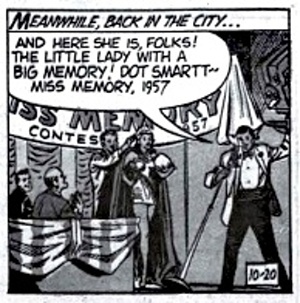
 Oct. 27, 1957


